Haloprogin is used as a topical ointment or cream in the treatment of Tinea infections. Tinea infections are superficial fungal infections caused by three species of fungi collectively known as... Commonly these infections are named for the body part affected, including tinea corporis (general skin), tinea cruris (groin), and tinea pedis (feet).
- Mechanism
- Curator reviewed
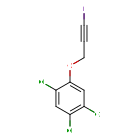
Haloprogin is a halogenated phenolic ether administered topically for dermotaphytic infections. The mechanism of action is unknown, but is thought to be via inhibition of oxygen uptake and disruption of yeast membrane structure and function. There is a higher incidence of cutaneous side effects with haloprogin, including irritation, burning, vesiculation (blisters), scaling, and itching. It is generally used when the infection is unresponsive to other antifungals.
- Primary indication
- Used to treat fungal (Tinea) skin infections such as athlete's foot, jock itch, ringworm, and tinea versicolor.Curator reviewed
- Formula / weight
- C9H4Cl3IO · 361.391 g/mol (avg)
- Code names
- M-1028 (MEIJI) · NSC-100071
Resolves to
CTETYYAZBPJBHE-UHFFFAOYSA-NSMILESClC1=CC(Cl)=C(Cl)C=C1OCC#CIWhat you can answer from here — as of September 23, 2026
Which companies are running trials of Haloprogin, in which indications and phases, and which of those programs are still active?
Create a free account or log in to explore the full data card.
Create Account