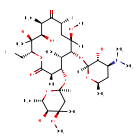
Clarithromycin is a macrolide antibiotic used for the treatment of a wide variety of bacterial infections such as acute otitis, pharyngitis, tonsillitis, respiratory tract infections, uncomplicated skin infections, and helicobacter pylori infection. Clarithromycin, a semisynthetic macrolide antibiotic derived from erythromycin, inhibits bacterial protein synthesis by binding to the bacterial 50S ribosomal subunit.
- Mechanism
- Curator reviewed
Clarithromycin is first metabolized to 14-OH clarithromycin, which is active and works synergistically with its parent compound. Like other macrolides, it then penetrates bacteria cell wall and reversibly binds to domain V of the 23S ribosomal RNA of the 50S subunit of the bacterial ribosome, blocking translocation of aminoacyl transfer-RNA and polypeptide synthesis. Clarithromycin also inhibits the hepatic microsomal CYP3A4 isoenzyme and P-glycoprotein, an energy-dependent drug efflux pump.
- Primary indication
- An alternative medication for the treatment of acute otitis media caused by H. influenzae, M. catarrhalis, or S. pneumoniae in patients with a history of type I penicillin hypersensitivity.Curator reviewed · 16 structured indications
- Formula / weight
- C38H69NO13 · 747.9534 g/mol (avg)
- First approval
- Canada, 2007 · United States, 1991
- Also known as
- 6-O-methyl erythromycin · 6-O-methylerythromycin · 6-O-methylerythromycin A
- Code names
- A-56268 · ABBOTT-56268 · TE-031
- Brand names
Resolves to
AGOYDEPGAOXOCK-KCBOHYOISA-NSMILES[H][C@@]1(C[C@@](C)(OC)[C@@H](O)[C@H](C)O1)O[C@H]1[C@H](C)[C@@H](O[C@]2([H])O[C@H](C)C[C@@H]([C@H]2O)N(C)C)[C@@](C)(C[C@@H](C)C(=O)[C@H](C)[C@@H](O)[C@](C)(O)[C@@H](CC)OC(=O)[C@@H]1C)OCWhat you can answer from here — as of September 23, 2026
Which drugs share a target with Clarithromycin, and which of those have an active Phase 3 trial?
Create a free account or log in to explore the full data card.
Create Account