Apan (PPI-1019) is developed by Praecis Pharmaceuticals to treat Alzheimer's Disease.
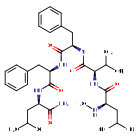
- Mechanism
- Curator reviewed
PPI-1019 (Apan) inhibits the aggregation of beta-amyloid and its associated nerve cell toxicity. In addition, Apan reaches the brain in quantities that are sufficient to block the aggregation of beta-amyloid molecules and alter the course of the disease.
Accumulation of beta-amyloid in the brain is often thought of as a defect in the ability to clear beta-amyloid from the brain through the cerebral spinal fluid (CSF). Both humans and transgenic mice with Alzheimer's disease plaques show increased levels of beta-amyloid in the brain and decreased levels in the CSF. Transgenic mice treated with Apan show significant increases in beta-amyloid levels in the CSF, indicating that Apan is able to mobilize beta-amyloid in the brain and may be facilitating its clearance.
- Primary indication
- Investigated for use/treatment in alzheimer's disease.Curator reviewed
- Formula / weight
- C36H54N6O5 · 650.865 g/mol (avg)
- Code names
- PPI-1019
Resolves to
TUSUWHFYKZZRIG-JQWMYKLHSA-NSMILESCN[C@H](CC(C)C)C(=O)N[C@H](C(C)C)C(=O)N[C@H](CC1=CC=CC=C1)C(=O)N[C@H](CC1=CC=CC=C1)C(=O)N[C@H](CC(C)C)C(N)=OWhat you can answer from here — as of June 12, 2020
Which companies are running trials of PPI-1019, in which indications and phases, and which of those programs are still active?
Create a free account or log in to explore the full data card.
Create Account