Sinapultide is a synthetic lung surfactant used to treat infant respiratory distress syndrome. This protein has a weight of 2469.40.
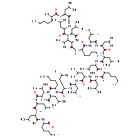
- Mechanism
- Curator reviewed · 2 references
Endogenous pulmonary surfactant lowers surface tension at the air-liquid interface of the alveolar surfaces during respiration and stabilizes the alveoli against collapse at resting transpulmonary pressures. A deficiency of pulmonary surfactant in premature infants results in RDS. Surfaxin, the drug in which this protein is included, compensates for the deficiency of surfactant and restores surface activity to the lungs of these infants.
To explore the mechanisms of protection that this sinapultide offers against RDS, in vitro assays were performed with human and murine endothelial cell monolayers, and polymorphonuclear leukocyte (PMN) transmigration in the presence or absence of KL(4)-surfactant or lipid controls was studied. Based on morphology, histopathology, white blood cell count, percentage of PMNs, and protein concentration in bronchoalveolar lavage fluid, the results that showed KL(4)-surfactant, blocked neutrophil influx into alveoli and thus prevented lung injury. Additionally, in vitro assays demonstrated KL(4)-surfactant decreased neutrophil transmigration at the endothelial cell level. KL(4)-surfactant diminished inflammation and lung permeability when compared with controls in both mouse models of lung injury. Evidence suggests the anti-inflammatory mechanism of the KL(4)-peptide is achieved through inhibition of PMN transmigration through the endothelium.
- Primary indication
- Infant respiratory distress syndrome.Curator reviewed
- Formula / weight
- C126H238N26O22 · 2469.45 g/mol (avg)
- First approval
- United States, 2013
- Code names
- ATI-01 · DSC-104 · KL-4 · RWJ-45652
Resolves to
QSIRXSYRKZHJHX-TWXHAJHVSA-NSMILESCC(C)C[C@H](NC(=O)[C@@H](N)CCCCN)C(=O)N[C@@H](CC(C)C)C(=O)N[C@@H](CC(C)C)C(=O)N[C@@H](CC(C)C)C(=O)N[C@@H](CCCCN)C(=O)N[C@@H](CC(C)C)C(=O)N[C@@H](CC(C)C)C(=O)N[C@@H](CC(C)C)C(=O)N[C@@H](CC(C)C)C(=O)N[C@@H](CCCCN)C(=O)N[C@@H](CC(C)C)C(=O)N[C@@H](CC(C)C)C(=O)N[C@@H](CC(C)C)C(=O)N[C@@H](CC(C)C)C(=O)N[C@@H](CCCCN)C(=O)N[C@@H](CC(C)C)C(=O)N[C@@H](CC(C)C)C(=O)N[C@@H](CC(C)C)C(=O)N[C@@H](CC(C)C)C(=O)N[C@@H](CCCCN)C(O)=OWhat you can answer from here — as of March 06, 2025
Which companies are running trials of Sinapultide, in which indications and phases, and which of those programs are still active?
Create a free account or log in to explore the full data card.
Create Account