Hydroxystilbamidine isethionate is used in the therapy of some patients with nonprogressive blastomycosis of the skin, and pulmonary or systemic blastomycosis in children, with fewer side effects than amphotericin B.... Hydroxystilbamidine isethionate is also used in pathology for diagnostic purposes.
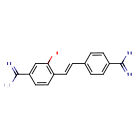
- Mechanism
- Curator reviewed
Hydroxystilbamidine isethionate (HSB) acts on extracellular DNA and lysosomes. In Trypanosomes there is extensive and selective binding of HSB to the kinetoplastic DNA. This inhibits cell division and reproduction. In yeast there is evidence of binding to extranuclear DNA causing numerous mutations. HSB is also taken up in the lysosomes and leads to a significant increase in the number of lysosome-like bodies and secretion granules in trypanosomal organisms. HSB may also stabilize lysosomal membranes. HSB has also been found to bind RNA and is a powerful inhibitor of cellular ribonucleases.
- Primary indication
- Used in the treatment of nonprogressive blastomycosis of the skin and other mycoses.Curator reviewed
- Formula / weight
- C16H16N4O · 280.331 g/mol (avg)
- Also known as
- Oxistilbamidinum
Resolves to
TUESWZZJYCLFNL-DAFODLJHSA-NSMILESNC(=N)C1=CC=C(\C=C\C2=C(O)C=C(C=C2)C(N)=N)C=C1What you can answer from here — as of September 23, 2026
Which companies are running trials of Hydroxystilbamidine, in which indications and phases, and which of those programs are still active?
Create a free account or log in to explore the full data card.
Create Account