Remdesivir is a nucleoside analog used to treat RNA virus infections including COVID-19. Severe acute respiratory syndrome coronavirus 2 (SARS-CoV-2) is the causative agent of coronavirus disease 2019 (COVID-19), which is a respiratory disease that is capable of progressing to viral pneumonia and acute respiratory distress syndrome (ARDS);...
- Mechanism
- Curator reviewed · 16 references
COVID-19 is caused by the positive-sense RNA virus severe acute respiratory syndrome coronavirus 2 (SARS-CoV-2). Replication of the viral genome is a key step in the infectious cycle of RNA viruses, including those of the Filoviridae, Paramyxoviridae, Pneumoviridae, and Coronaviridae families, and is carried out by viral RNA-dependent RNA polymerase (RdRp) enzymes or enzyme complexes. For both SARS-CoV and SARS-CoV-2, the RdRp comprises nsp7, nsp8, and nsp12 subunits under physiological conditions, although functional RdRp complexes can be reassembled in vitro that incorporate only the nsp8 and nsp12 subunits, similar to the Middle East respiratory syndrome coronavirus (MERS-CoV).
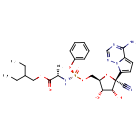
Remdesivir is a phosphoramidite prodrug of a 1'-cyano-substituted adenosine nucleotide analogue that competes with ATP for incorporation into newly synthesized viral RNA by the corresponding RdRp complex. Remdesivir enters cells before being cleaved to its monophosphate form through the action of either carboxylesterase 1 or cathepsin A; it is subsequently phosphorylated by undescribed kinases to yield its active triphosphate form remdesivir triphosphate (RDV-TP or GS-443902). RDV-TP is efficiently incorporated by the SARS-CoV-2 RdRp complex, with a 3.65-fold selectivity for RDV-TP over endogenous ATP. Unlike some nucleoside analogues, remdesivir provides a free 3'-hydroxyl group that allows for continued chain elongation. However, modelling and in vitro experiments suggest that at i + 4 (corresponding to the position for the incorporation of the fourth nucleotide following RDV-TP incorporation), the 1'-cyano group of remdesivir sterically clashes with Ser-861 of the RdRp, preventing further enzyme translocation and terminating replication at position i + 3. This mechanism was essentially identical between SARS-CoV, SARS-CoV-2, and MERS-CoV, and genomic comparisons reveal that Ser-861 is conserved across alpha-, beta-, and deltacoronaviruses, suggesting remdesivir may possess broad antiviral activity.
Considerations for the use of nucleotide analogues like remdesivir include the possible accumulation of resistance mutations. Excision of analogues through the 3'-5' exonuclease (ExoN) activity of replication complexes, mediated in SARS-CoV by the nsp14 subunit, is of possible concern. Murine hepatitis viruses (MHVs) engineered to lack ExoN activity are approximately 4-fold more susceptible to remdesivir, supporting the proposed mechanism of action. However, the relatively mild benefit of ExoN activity to remdesivir resistance is proposed to involve its delayed chain termination mechanism, whereby additional endogenous nucleotides are incorporated following RDV-TP. In addition, serial passage of MHV in increasing concentrations of the remdesivir parent molecule GS-441524 led to the development of resistance mutations F476L and V553L, which maintain activity when transferred to SARS-CoV. However, these mutant viruses are less fit than wild-type in both competition assays and in vivo in the absence of selective pressure. To date, no clinical data on SARS-CoV-2 resistance to remdesivir have been described.
- Primary indication
- Remdesivir is indicated for the treatment of adult and pediatric patients 28 days of age and older and weighing at least 3 kg for coronavirus disease 2019 (COVID-19) infection requiring hospitalization.Curator reviewed · 13 structured indications
- Formula / weight
- C27H35N6O8P · 602.585 g/mol (avg)
- First approval
- Canada, 2020 · United States, 2020 · European Union, 2021
- Code names
- GS-5734
- Brand names
Resolves to
RWWYLEGWBNMMLJ-YSOARWBDSA-NSMILESCCC(CC)COC(=O)[C@H](C)N[P@](=O)(OC[C@H]1O[C@](C#N)([C@H](O)[C@@H]1O)C1=CC=C2N1N=CN=C2N)OC1=CC=CC=C1What you can answer from here — as of September 13, 2026
Which drugs share a target with Remdesivir, and which of those have an active Phase 3 trial?
Create a free account or log in to explore the full data card.
Create Account