Lidocaine hydrochlorideProduct ingredient for Lidocaine
- Name
- Lidocaine hydrochloride
- Drug Entry
- Lidocaine
Ever since its discovery and availability for sale and use in the late 1940s, lidocaine has become an exceptionally commonly used medication 6. In particular, lidocaine's principal mode of action in acting as a local anesthetic that numbs the sensations of tissues means the agent is indicated for facilitating local anesthesia for a large variety of surgical procedures 10,7,8. It ultimately elicits its numbing activity by blocking sodium channels so that the neurons of local tissues that have the medication applied on are transiently incapable of signaling the brain regarding sensations 10,7,8. In doing so, however, it can block or decrease muscle contractile, resulting in effects like vasodilation, hypotension, and irregular heart rate, among others 10,7,8. As a result, lidocaine is also considered a class Ib anti-arrhythmic agent 7,8,12. Nevertheless, lidocaine's local anesthetic action sees its use in many medical situations or circumstances that may benefit from its action, including the treatment of premature ejaculation 5.
Regardless, lidocaine is currently available as a relatively non-expensive generic medication that is written for in millions of prescriptions internationally on a yearly basis. It is even included in the World Health Organization's List of Essential Medicines 9.
- Accession Number
- DBSALT000900
- Structure

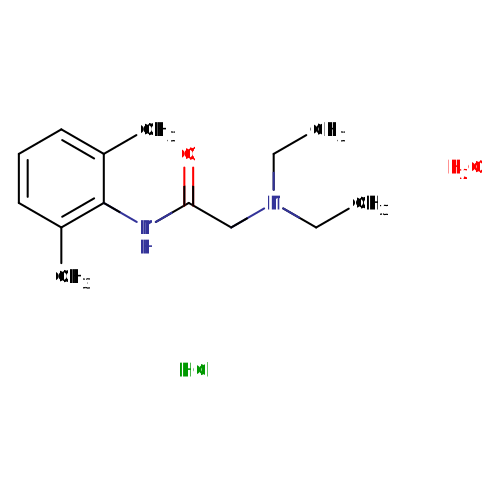
Structure for Lidocaine hydrochloride (DBSALT000900)
- Synonyms
- Lidocaine HCl / Lidocaine HCl hydrate / Lidocaine Hydrochloride / Lidocaine hydrochloride monohydrate