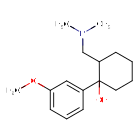
Tramadol is a centrally-acting opioid agonist and SNRI (serotonin/norepinephrine reuptake inhibitor) used for the management of moderate to severe pain in adults. Tramadol is a centrally acting synthetic opioid analgesic and SNRI (serotonin/norepinephrine reuptake-inhibitor) that is structurally related to codeine and morphine.
- Mechanism
- Curator reviewed · 9 references
Tramadol is a centrally acting μ-opioid receptor agonist and SNRI (serotonin/norepinephrine reuptake-inhibitor) that is structurally related to codeine and morphine. Tramadol binds weakly to κ- and δ-opioid receptors and to the μ-opioid receptor with 6000-fold less affinity than morphine.
Tramadol exists as a racemic mixture consisting of two pharmacologically active enantiomers that both contribute to its analgesic property through different mechanisms: (+)-tramadol and its primary metabolite (+)-O-desmethyl-tramadol (M1) are agonists of the μ opioid receptor while (+)-tramadol inhibits serotonin reuptake and (-)-tramadol inhibits norepinephrine reuptake. These pathways are complementary and synergistic, improving tramadol's ability to modulate the perception of and response to pain.
In animal models, M1 is up to 6 times more potent than tramadol in producing analgesia and 200 times more potent in μ-opioid binding.
Tramadol has also been shown to affect a number of pain modulators including alpha2-adrenoreceptors, neurokinin 1 receptors, the voltage-gated sodium channel type II alpha subunit, transient receptor potential cation channel subfamily V member 1 (TRPV1 - also known as the capsaicin receptor), muscarinic receptors (M1 and M3), N-methyl-D-aspartate receptor (also known as the NMDA receptor or glutamate receptor), Adenosine A1 receptors, and nicotinic acetylcholine receptor.
In addition to the above neuronal targets, tramadol has a number of effects on inflammatory and immune mediators involved in the pain response. This includes inhibitory effects on cytokines, prostaglandin E2 (PGE2), nuclear factor-κB, and glial cells as well as a change in the polarization state of M1 macrophages.
- Primary indication
- Tramadol is approved for the management of moderate to severe pain in adults.Curator reviewed · 10 structured indications
- Formula / weight
- C16H25NO2 · 263.381 g/mol (avg)
- First approval
- Canada, 2005 · United States, 1995
- Code names
- CG-315E · E-265 · ETS-6103 · U-26255A
- Brand names
Resolves to
TVYLLZQTGLZFBW-UHFFFAOYSA-NSMILESCOC1=CC=CC(=C1)C1(O)CCCCC1CN(C)CWhat you can answer from here — as of September 23, 2026
Which drugs share a target with Tramadol, and which of those have an active Phase 3 trial?
Create a free account or log in to explore the full data card.
Create Account