Digoxin is a cardiac glycoside used in the treatment of mild to moderate heart failure and for ventricular response rate control in chronic atrial fibrillation. Digoxin is one of the oldest cardiovascular medications used today.
- Mechanism
- Curator reviewed · 10 references
Digoxin exerts hemodynamic, electrophysiologic, and neurohormonal effects on the cardiovascular system. It reversibly inhibits the Na-K ATPase enzyme, leading to various beneficial effects. The Na-K ATPase enzyme functions to maintain the intracellular environment by regulating the entry and exit of sodium, potassium, and calcium (indirectly). Na-K ATPase is also known as the sodium pump. The inhibition of the sodium pump by digoxin increases intracellular sodium and increases the calcium level in the myocardial cells, causing an increased contractile force of the heart. This improves the left ventricular ejection fraction (EF), an important measure of cardiac function.
Digoxin also stimulates the parasympathetic nervous system via the vagus nerve leading to sinoatrial (SA) and atrioventricular (AV) node effects, decreasing the heart rate. Part of the pathophysiology of heart failure includes neurohormonal activation, leading to an increase in norepinephrine. Digoxin helps to decrease norepinephrine levels through activation of the parasympathetic nervous system.
- Primary indication
- Digoxin is indicated in the following conditions: 1) For the treatment of mild to moderate heart failure in adult patients.Curator reviewed · 3 structured indications
- Formula / weight
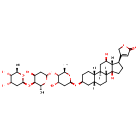
- C41H64O14 · 780.9385 g/mol (avg)
- First approval
- Canada, 2005 · United States, 1975
- Code names
- NSC-95100
- Brand names
Resolves to
LTMHDMANZUZIPE-PUGKRICDSA-NSMILES[H][C@]12CC[C@]3([H])[C@]([H])(C[C@@H](O)[C@]4(C)[C@H](CC[C@]34O)C3=CC(=O)OC3)[C@@]1(C)CC[C@@H](C2)O[C@H]1C[C@H](O)[C@H](O[C@H]2C[C@H](O)[C@H](O[C@H]3C[C@H](O)[C@H](O)[C@@H](C)O3)[C@@H](C)O2)[C@@H](C)O1What you can answer from here — as of September 16, 2026
Which drugs share a target with Digoxin, and which of those have an active Phase 3 trial?
Create a free account or log in to explore the full data card.
Create Account