Capecitabine is a nucleoside metabolic inhibitor indicated to treat different gastrointestinal, including pancreatic cancer, and breast cancer. Capecitabine is an orally-administered chemotherapeutic agent used in the treatment of metastatic breast and colorectal cancers.
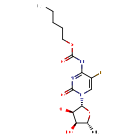
- Mechanism
- Curator reviewed · 34 references
Capecitabine is metabolized to 5-fluorouracil in vivo by carboxylesterases, cytidine deaminase, and thymidine phosphorylase/uridine phosphorylase sequentially. 5-fluorouracil is further metabolized through a series of enzymatic reactions into 3 main active metabolites: 5-fluorouridine triphosphate (5-FUTP), 5-fluoro-2’-deoxyuridine monophosphate (5-FdUMP), and 5-fluorodeoxyuridine triphosphate (5-FdUTP).. These metabolites cause cell injury by two different mechanisms. First, FdUMP and the folate cofactor, N5-10-methylenetetrahydrofolate (CH2THF), bind to thymidylate synthase (TS) to form a covalently bound ternary complex. TS is an enzyme that catalyzes the methylation of deoxyuridine monophosphate (dUMP) to deoxythymidine monophosphate (dTMP). Under normal physiological conditions, dUMP binds to TS first before CH2THF, followed by a 1,4 or Michael addition from the pyrimidine C (6)atom to the Cys146 nucleophile. If correctly positioned, dUMP, CH2THF, and TS would form a ternary complex to facilitate the donation of the methyl group from CH2THF to dUMP. However, the substitution of dUMP with FdUMP results in a new time-dependent TS–FdUMP–CH2THF complex. Since the fluorine group prevents dissociation of FdUMP from the pyrimidine ring, the whole complex is rendered irreversibly deactivated, terming this reaction "suicide inhibition". TS inhibition prevents the conversion of dUMP to dTMP, depleting the pool of dTMP that could be phosphorylated into dTTP to be incorporated as DNA nucleotides. This disrupts the nucleotides balance, particularly the the ATP/dTTP ratio, thus impairing DNA synthesis and repair and causing apoptosis.
5-FdUMP can also be phosphorylated into 5-FdUTP, further increasing the pool of dUTP base to potentially overwhelm the activity of dUTPase. Coupled with the decrease in dTTP, 5-FdUMP, and 5-FdUTP increase the probability of mistakenly incorporating a uracil base into DNA strands in place of thymine. Although this mistake can often be resolved by the nucleotide excision repair enzyme uracil-DNA-glycosylase (UDG), the high (F)dUTP/dTTP ratio would result in re-incorporation of uracil into DNA, leading to a futile cycle of misincorporation, excision, and repair. Repeated base excision repair can result in abasic sites, which can lead to DNA mutagenesis and thus protein miscoding, replication forks collapse, and DNA fragmentation through single or double strand breaks
However, several reports have found that the incorporation of uracil in genomic DNA does not significantly affect the cytotoxicity of 5-FU, suggesting that the cytotoxic effect of 5-FU is dominated by the perturbation of RNA through 5-FUTP. Similar to 5-dFUTP, 5-FUTP can be mistakenly incorporated into RNA in place of regular UTP and disrupt regular RNA biology through various mechanisms. 5-FUTP can be incorporated into the spliceosomal U2 snRNA at pseudouridylated sites to prevent further pseudouridylation and thus pre-mrNA splicing. 5-FUTP can also change the structure of U4 and U6 snRNA and reduce the turnover rate of U1 snrNA once incorporated. For tRNA, 5-FUTP can affect tRNA's post-transcriptional RNA modifications activity, particularly by inhbiting pseudouridine synthase through formation of covalent complex. Recently, the effect of 5-FUTP on miRNAs and lncRNA was also observed through profound changes in expression, although the precise mechanism is still unknown.
Although the main mechanism of 5-FU cytotoxicity was thought to be attributed to DNA damages, recent reports have shown that the majority of 5-FU pharmacological action is mediated through RNA, since 5-FU is accumulated ~3000- to 15 000-fold more in RNA compared to that of DNA.
- Primary indication
- Capecitabine is indicated as treatment for a variety of cancer types.Curator reviewed · 23 structured indications
- Formula / weight
- C15H22FN3O6 · 359.3501 g/mol (avg)
- First approval
- Canada, 2013 · United States, 1998 · European Union, 2016
- Code names
- R340 · RO 09-1978/000
- Brand names
Resolves to
GAGWJHPBXLXJQN-UORFTKCHSA-NSMILESCCCCCOC(=O)NC1=NC(=O)N(C=C1F)[C@@H]1O[C@H](C)[C@@H](O)[C@H]1OWhat you can answer from here — as of September 23, 2026
Which drugs share a target with Capecitabine, and which of those have an active Phase 3 trial?
Create a free account or log in to explore the full data card.
Create Account