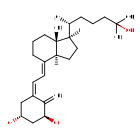
Calcitriol is an active metabolite of vitamin D that is used to treat hyperparathyroidism and is also used in dialysis patients to combat hypocalcemia. Calcitriol is an active metabolite of vitamin D with 3 hydroxyl (OH) groups and is commonly referred to as 1,25-dihydroxycholecalciferol, or 1alpha,25-dihydroxyvitamin D3, 1,25-dihydroxyvitamin D3.
- Mechanism
- Curator reviewed · 2 references
The mechanism of action of calcitriol in the treatment of psoriasis is accounted for by their antiproliferative activity for keratinocytes and their stimulation of epidermal cell differentiation. The anticarcinogenic activity of the active form of Calcitriol appears to be correlated with cellular vitamin D receptor (VDR) levels. Vitamin D receptors belong to the superfamily of steroid-hormone zinc-finger receptors. VDRs selectively bind 1,25-(OH)2-D3 and retinoic acid X receptor (RXR) to form a heterodimeric complex that interacts with specific DNA sequences known as vitamin D-responsive elements. VDRs are ligand-activated transcription factors. The receptors activate or repress the transcription of target genes upon binding their respective ligands. It is thought that the anticarcinogenic effect of Calcitriol is mediated via VDRs in cancer cells. The immunomodulatory activity of calcitriol is thought to be mediated by vitamin D receptors (VDRs) which are expressed constitutively in monocytes but induced upon activation of T and B lymphocytes. 1,25-(OH)2-D3 has also been found to enhance the activity of some vitamin D-receptor positive immune cells and to enhance the sensitivity of certain target cells to various cytokines secreted by immune cells.
A study suggests that calcitriol plays an immunoregulatry role by suppressing the aryl hydrocarbon receptor (AhR) expression in human Th9, a pro-inflammatory CD4 T cell subset. This suppression subsequently leads to repressed expression of BATF, a transcription factor essential for Th9. Calcitriol has also been found to induce monocyte differentiation and to inhibit lymphocyte proliferation and production of cytokines, including interleukin IL-1 and IL-2, as well as to suppress immunoglobulin secretion by B lymphocytes.
- Primary indication
- Used to treat vitamin D deficiency or insufficiency, refractory rickets (vitamin D resistant rickets), familial hypophosphatemia and hypoparathyroidism, and in the management of hypocalcemia and renal osteodystrophy in patients with chronic renal failure undergoing dialysis.Curator reviewed · 6 structured indications
- Formula / weight
- C27H44O3 · 416.6365 g/mol (avg)
- First approval
- Canada, 2009 · United States, 2001
- Also known as
- 1-alpha-25-Dihydroxyvitamin D3
- Code names
- DN-101 · RO 21-5535
- Brand names
Resolves to
GMRQFYUYWCNGIN-NKMMMXOESA-NSMILESC[C@H](CCCC(C)(C)O)[C@@]1([H])CC[C@@]2([H])\C(CCC[C@]12C)=C\C=C1\C[C@@H](O)C[C@H](O)C1=CWhat you can answer from here — as of September 23, 2026
Which drugs share a target with Calcitriol, and which of those have an active Phase 3 trial?
Create a free account or log in to explore the full data card.
Create Account