Buprenorphine is a partial opioid agonist used for management of severe pain that is not responsive to alternative treatments. Also used for maintenance treatment of opioid addiction. Buprenorphine is commercially available as the brand name product Suboxone which is formulated in a 4:1 fixed-dose combination product along with naloxone, a non-selective competitive opioid receptor antagonist.
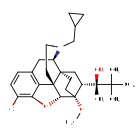
- Mechanism
- Curator reviewed · 6 references
Buprenorphine is a partial agonist at the mu-opioid receptor and an antagonist at the kappa-opioid receptor. It demonstrates a high affinity for the mu-opioid receptor but has lower intrinsic activity compared to other full mu-opioid agonists such as heroin, oxycodone, or methadone. This means that buprenorphine preferentially binds the opioid receptor and displaces lower affinity opioids without activating the receptor to a comparable degree. Clinically, this results in a slow onset of action and a clinical phenomenon known as the "ceiling effect" where once a certain dose is reached buprenorphine's effects plateau. This effect can be beneficial, however, as dose-related side effects such as respiratory depression, sedation, and intoxication also plateau at around 32mg, resulting in a lower risk of overdose compared to methadone and other full agonist opioids. It also means that opioid-dependent patients do not experience sedation or euphoria at the same rate that they might experience with more potent opioids, improving quality of life for patients with severe pain and reducing the reinforcing effects of opioids which can lead to drug-seeking behaviours.
Buprenorphine's high affinity, but low intrinsic activity for the mu-opioid receptor also means that if it is started in opioid-dependent individuals, it will displace the other opioids without creating an equal opioid effect and cause a phenomenon known as "precipitated withdrawal" which is characterized by a rapid and intense onset of withdrawal symptoms (i.e. anxiety, restlessness, gastrointestinal distress, diaphoresis, intense drug cravings, and tachycardia). Individuals must therefore be in a state of mild to moderate withdrawal before starting therapy with buprenorphine.
Buprenorphine is commercially available as the brand name product Suboxone which is formulated in a 4:1 fixed-dose combination product along with naloxone, a non-selective competitive opioid receptor antagonist. Combination of an opioid agonist with an opioid antagonist may seem counterintuitive, however this combination with naloxone is intended to reduce the abuse potential of Suboxone, as naloxone is poorly absorbed by the oral route (and has no effect when taken orally), but would reverse the opioid agonist effects of buprenorphine if injected intravenously.
- Primary indication
- Buprenorphine is available in different formulations, such as sublingual tablets, buccal films, transdermal films, and injections, alone or in combination with naloxone.Curator reviewed · 5 structured indications
- Formula / weight
- C29H41NO4 · 467.6401 g/mol (avg)
- First approval
- Canada, 2010 · United States, 1985 · European Union, 2016
- Also known as
- Buprenophine
- Brand names
Resolves to
RMRJXGBAOAMLHD-IHFGGWKQSA-NSMILESCO[C@]12CC[C@@]3(C[C@@H]1[C@](C)(O)C(C)(C)C)[C@H]1CC4=C5C(O[C@@H]2[C@@]35CCN1CC1CC1)=C(O)C=C4What you can answer from here — as of September 23, 2026
Which drugs share a target with Buprenorphine, and which of those have an active Phase 3 trial?
Create a free account or log in to explore the full data card.
Create Account