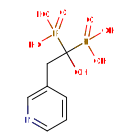
Risedronic acid is a bisphosphonate used to treat osteoporosis and Paget's disease. It functions by preventing resorption of bone.
- Mechanism
- Curator reviewed · 3 references
Risedronatic acid binds to bone hydroxyapatite. Bone resorption causes local acidification, releasing risedronic acid which is that taken into osteoclasts by fluid-phase endocytosis. Endocytic vesicles are acidified, releasing risedronic acid to the cytosol of osteoclasts where they induce apoptosis through inhbition of farnesyl pyrophosphate synthase. Inhibition of osteoclasts results in decreased bone resorption.
- Primary indication
- Risedronic acid is indicated for the treatment of osteoperosis in men, treatment of Paget's disease, treatment and prevention of osteoperosis in postmenopausal women, and treatment and prevention of glucocorticoid-induced osteoperosis.Curator reviewed · 11 structured indications
- Formula / weight
- C7H11NO7P2 · 283.1123 g/mol (avg)
- First approval
- Canada, 2010 · United States, 1998
- Also known as
- Risedronate
- Code names
- NE-58095
- Brand names
Resolves to
IIDJRNMFWXDHID-UHFFFAOYSA-NSMILESOC(CC1=CN=CC=C1)(P(O)(O)=O)P(O)(O)=OWhat you can answer from here — as of September 13, 2026
Which drugs share a target with Risedronic acid, and which of those have an active Phase 3 trial?
Create a free account or log in to explore the full data card.
Create Account