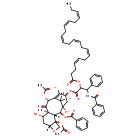
A combination of docosahexaenoic Acid (a natural fatty acid) and paclitaxel (an anticancer drug) being studied in the treatment of cancer. It is a type of mitotic inhibitor.
- Mechanism
- Curator reviewed
A prodrug comprised of the naturally occurring omega-3 fatty acid docosahexaenoic acid (DHA) covalently conjugated to the anti-microtubule agent paclitaxel. Because tumor cells take up DHA, DHA-paclitaxel is delivered directly to tumor tissue, where the paclitaxel moiety binds to tubulin and inhibits the disassembly of microtubules, thereby resulting in the inhibition of cell division. Paclitaxel also induces apoptosis by binding to and blocking the function of the apoptosis inhibitor protein Bcl-2 (B-cell Leukemia 2). DHA-paclitaxel exhibits improved pharmacokinetic and toxicity profiles when compared to conventional paclitaxel and has demonstrated antineoplastic activity in animal models of cancer.
- Primary indication
- Investigated for use/treatment in breast cancer, colorectal cancer, gastric cancer, kidney cancer, lung cancer, pancreatic cancer, prostate cancer, and skin cancer.Curator reviewed
- Formula / weight
- C69H81NO15 · 1164.3791 g/mol (avg)
- Also known as
- DHA Paclitaxel · DHA-paclitaxel · Paclitaxel docosahexaenoic acid ester · PACLITAXEL-DHA · Taxoprexin
Resolves to
LRCZQSDQZJBHAF-PUBGEWHCSA-NSMILESCC\C=C/C\C=C/C\C=C/C\C=C/C\C=C/C\C=C/CCC(=O)O[C@@H](C(=O)O[C@H]1C[C@@]2(O)[C@@H](OC(=O)C3=CC=CC=C3)[C@@]3([H])[C@@](C)([C@@H](O)C[C@@]4([H])OC[C@@]34OC(=O)C)C(=O)[C@H](OC(=O)C)C(=C1C)C2(C)C)[C@@H](NC(=O)C1=CC=CC=C1)C1=CC=CC=C1What you can answer from here — as of September 16, 2025
Which drugs share a target with Paclitaxel docosahexaenoic acid, and which of those have an active Phase 3 trial?
Create a free account or log in to explore the full data card.
Create Account