Xanomeline tartrateProduct ingredient for Xanomeline
- Name
- Xanomeline tartrate
- Drug Entry
- Xanomeline
Schizophrenia is a complex disease involving a number of different neurotransmitters, including serotonin, dopamine, and acetylcholine.1 Positive symptoms (e.g. hallucinations, delusions) have traditionally been attributed to increased dopaminergic activity in mesolimbic pathways, whereas negative symptoms (e.g. apathy, anhedonia) and cognitive impairment have been attributed to decreased dopaminergic activity in mesocortical pathways.1 Positive symptoms of schizophrenia are more amenable to drug therapy, whereas negative symptoms and cognitive impairment have proven more difficult to treat.1 Advances in pre-clinical research and findings in clinical trials have led to a resurgence of interest in the cognition-enhancing potential of muscarinic agonists in schizophrenia, as it was discovered that M1 and M4 muscarinic acetylcholine receptors are highly expressed in brain regions that are implicated in cognition.2
Xanomeline is a muscarinic agonist that was approved for the treatment of schizophrenia by the FDA in September 2024, becoming the first approved treatment for schizophrenia to target muscarinic receptors as opposed to dopamine receptors.4 It is approved as part of a combination product alongside trospium, a muscarinic antagonist that acts primarily on peripheral muscarinic receptors in order to mitigate the risk and severity of peripheral cholinergic adverse effects.3
- Accession Number
- DBSALT003557
- Structure
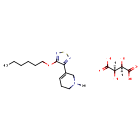
Structure for Xanomeline tartrate (DBSALT003557)

- Synonyms
- Not Available
- External IDs
- LY-246708 tartrate / LY246708 tartrate