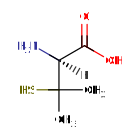
Penicillamine is a chelator used to treat Wilson's disease, cystinuria, and rheumatoid arthritis. The pharmaceutical form is D-penicillamine, as L-penicillamine is toxic (it inhibits the action of pyridoxine).
- Mechanism
- Curator reviewed
Penicillamine is a chelating agent recommended for the removal of excess copper in patients with Wilson's disease. From in vitro studies which indicate that one atom of copper combines with two molecules of penicillamine. Penicillamine also reduces excess cystine excretion in cystinuria. This is done, at least in part, by disulfide interchange between penicillamine and cystine, resulting in formation of penicillamine-cysteine disulfide, a substance that is much more soluble than cystine and is excreted readily. Penicillamine interferes with the formation of cross-links between tropocollagen molecules and cleaves them when newly formed. The mechanism of action of penicillamine in rheumatoid arthritis is unknown although it appears to suppress disease activity. Unlike cytotoxic immunosuppressants, penicillamine markedly lowers IgM rheumatoid factor but produces no significant depression in absolute levels of serum immunoglobulins. Also unlike cytotoxic immunosuppressants which act on both, penicillamine in vitro depresses T-cell activity but not B-cell activity.
- Primary indication
- For treatment of Wilson's disease, cystinuria and active rheumatoid arthritis.Curator reviewed · 5 structured indications
- Formula / weight
- C5H11NO2S · 149.211 g/mol (avg)
- First approval
- Canada, 2005 · United States, 1970
- Also known as
- (S)-3,3-dimethylcysteine · D-penicillamine
- Code names
- NSC-81549
- Brand names
Resolves to
VVNCNSJFMMFHPL-VKHMYHEASA-NSMILES[H][C@](N)(C(O)=O)C(C)(C)SWhat you can answer from here — as of September 23, 2026
Which other approved drugs treat the same conditions as Penicillamine, and which companies have late-stage candidates in those indications?
Create a free account or log in to explore the full data card.
Create Account