Pyrazinamide is an antituberculosis agent used as a component of tuberculosis (TB) treatment. A pyrazine that is used therapeutically as an antitubercular agent.
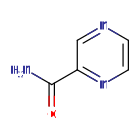
- Mechanism
- Curator reviewed · 4 references
Pyrazinamide diffuses into active M. tuberculosis that express pyrazinamidase enzyme that converts pyrazinamide to the active form pyrazinoic acid. Pyrazinoic acid can leak out under acidic conditions to be converted to the protonated conjugate acid, which is readily diffused back into the bacilli and accumulate intracellularly. The net effect is that more pyrazinoic acid accumulates inside the bacillus at acid pH than at neutral pH. Pyrazinoic acid was thought to inhibit the enzyme fatty acid synthase (FAS) I, which is required by the bacterium to synthesise fatty acids. However, this theory was thought to have been discounted. However, further studies reproduced the results of FAS I inhibition as the putative mechanism first in whole cell assay of replicating M. tuberculosis bacilli which have shown that pyrazinoic acid and its ester inhibit the synthesis of fatty acids. This study was followed by in vitro assay of tuberculous FAS I enzyme that tested the activity with pyrazinamide, pyrazinoic acid and several classes of pyrazinamide analogs. Pyrazinamide and its analogs inhibited the activity of purified FAS I.
It has also been suggested that the accumulation of pyrazinoic acid disrupts membrane potential and interferes with energy production, necessary for survival of M. tuberculosis at an acidic site of infection. Pyrazinoic acid has also been shown to bind to the ribosomal protein S1 (RpsA) and inhibit trans-translation. This may explain the ability of the drug to kill dormant mycobacteria.
- Primary indication
- For the initial treatment of active tuberculosis in adults and children when combined with other antituberculous agents.Curator reviewed · 2 structured indications
- Formula / weight
- C5H5N3O · 123.1127 g/mol (avg)
- First approval
- Canada, 2006 · United States, 1971
- Also known as
- 2-carbamylpyrazine · 2-pyrazinecarboxamide · Aldinamide · Pirazinamide · Pyrazine carboxamide
- Code names
- D-50 · MK-56 · NSC-14911 · PZA
- Brand names
Resolves to
IPEHBUMCGVEMRF-UHFFFAOYSA-NSMILESNC(=O)C1=NC=CN=C1What you can answer from here — as of August 30, 2026
Which drugs share a target with Pyrazinamide, and which of those have an active Phase 3 trial?
Create a free account or log in to explore the full data card.
Create Account