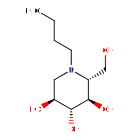
Miglustat is a glucosylceramide synthase inhibitor used for the management of mild to moderate type I Gaucher disease for patients who are not candidates for whole enzyme replacement. Miglustat, commonly marketed under the trade name Zavesca, is a drug used to treat Gaucher disease.
- Mechanism
- Curator reviewed
Miglustat functions as a competitive and reversible inhibitor of the enzyme glucosylceramide synthase, the initial enzyme in a series of reactions which results in the synthesis of most glycosphingolipids. The goal of treatment with miglustat is to reduce the rate of glycosphingolipid biosynthesis so that the amount of glycosphingolipid substrate is reduced to a level which allows the residual activity of the deficient glucocerebrosidase enzyme to be more effective (substrate reduction therapy), reducing the accumulation of glucocerebroside in macrophages. In vitro and in vivo studies have shown that miglustat can reduce the synthesis of glucosylceramide-based glycosphingolipids. In clinical trials, miglustat improved liver and spleen volume, as well as hemoglobin concentration and platelet count. Inhibition of glycosphingolipid synthesis has also shown to reduce intracellular lipid storage, improve fluid-phase endosomal uptake and normalize lipid transport in peripheral blood B lymphocytes of NP-C patients, which results in a decrease in the potentially neurotoxic accumulation of gnagliosides GM2 and GM3, lactosylceramide and glucosylceramide, possibly preventing further neuronal damage. Other studies have also suggested that miglustat may indirectly modulate intracellular calcium homeostasis through its effects on glucosylceramide levels, and evidence has shown that an initiating factor in the pathogenesis of NP-C may be impaired calcium homeostasis related to sphingosine storage. Therefore, the effect that miglustat exerts on intracellular calcium levels may influence an important underlying pathogenic mechanism of NP-C.
- Primary indication
- For the treatment of adult patients with mild to moderate type 1 (nonneuropathic) Gaucher's disease for whom enzyme replacement therapy is not a therapeutic option (e.g. due to constraints such as allergy, hypersensitivity, or poor...Curator reviewed · 1 structured indication
- Formula / weight
- C10H21NO4 · 219.278 g/mol (avg)
- First approval
- Canada, 2016 · United States, 2003 · European Union, 2016
- Also known as
- 1,5-(butylimino)-1,5-dideoxy, D-glucitol · AT2221 · BuDNJ · Butyldeoxynojirimycin · n-Butyl deoxynojirimycin
- Code names
- OGT-918 · SC-48334
- Brand names
Resolves to
UQRORFVVSGFNRO-UTINFBMNSA-NSMILESCCCCN1C[C@H](O)[C@@H](O)[C@H](O)[C@H]1COWhat you can answer from here — as of September 23, 2026
Which drugs share a target with Miglustat, and which of those have an active Phase 3 trial?
Create a free account or log in to explore the full data card.
Create Account