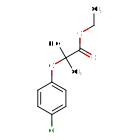
Clofibrate is a fibric acid derivative used to treat hypertriglyceridemia and high cholesterol. (From Martindale, The Extra Pharmacopoeia, 30th ed, p986).
- Mechanism
- Curator reviewed
Clofibrate increases the activity of extrahepatic lipoprotein lipase (LL), thereby increasing lipoprotein triglyceride lipolysis. Chylomicrons are degraded, VLDLs are converted to LDLs, and LDLs are converted to HDL. This is accompanied by a slight increase in secretion of lipids into the bile and ultimately the intestine. Clofibrate also inhibits the synthesis and increases the clearance of apolipoprotein B, a carrier molecule for VLDL. Also, as a fibrate, Clofibrate is an agonist of the PPAR-α receptor in muscle, liver, and other tissues. This agonism ultimately leads to modification in gene expression resulting in increased beta-oxidation, decreased triglyceride secretion, increased HDL, increased lipoprotein lipase activity.
- Primary indication
- For Primary Dysbetalipoproteinemia (Type III hyperlipidemia) that does not respond adequately to diet.Curator reviewed
- Formula / weight
- C12H15ClO3 · 242.699 g/mol (avg)
- First approval
- Canada, 1968
- Also known as
- EPIB · Ethyl chlorophenoxyisobutyrate · Ethyl clofibrate · Liprin
- Code names
- AY-61123 · ICI-28257 · NSC-79389
Resolves to
KNHUKKLJHYUCFP-UHFFFAOYSA-NSMILESCCOC(=O)C(C)(C)OC1=CC=C(Cl)C=C1What you can answer from here — as of September 23, 2026
Which drugs share a target with Clofibrate, and which of those have an active Phase 3 trial?
Create a free account or log in to explore the full data card.
Create Account