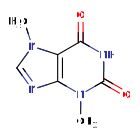
Theobromine (3,7-dimethylxanthine) is the principle alkaloid in Theobroma cacao (the cacao bean) and other plants. A xanthine alkaloid that is used as a bronchodilator and as a vasodilator. It has... It has a weaker diuretic activity than theophylline and is also a less powerful stimulant of smooth muscle.
- Mechanism
- Curator reviewed
Theobromine stimulates medullary, vagal, vasomotor, and respiratory centers, promoting bradycardia, vasoconstriction, and increased respiratory rate. This action was previously believed to be due primarily to increased intracellular cyclic 3′,5′-adenosine monophosphate (cyclic AMP) following inhibition of phosphodiesterase, the enzyme that degrades cyclic AMP. It is now thought that xanthines such as caffeine and theobromine act as antagonist at adenosine-receptors within the plasma membrane of virtually every cell. As adenosine acts as an autocoid, inhibiting the release of neurotransmitters from presynaptic sites but augmenting the actions of norepinephrine or angiotensin, antagonism of adenosine receptors promotes neurotransmitter release. This explains the stimulatory effects of xanthine derivatives such as theobromine and caffeine. Blockade of the adenosine A1 receptor in the heart leads to the accelerated, pronounced "pounding" of the heart upon caffeine intake.
- Primary indication
- theobromine is used as a vasodilator, a diuretic, and heart stimulant.Curator reviewed
- Formula / weight
- C7H8N4O2 · 180.164 g/mol (avg)
- Also known as
- 3,7-dimethylxanthine
- Code names
- FEMA NO. 3591 · NSC-5039 · SC-15090
Resolves to
YAPQBXQYLJRXSA-UHFFFAOYSA-NSMILESCN1C=NC2=C1C(=O)NC(=O)N2CWhat you can answer from here — as of September 23, 2026
Which drugs share a target with Theobromine, and which of those have an active Phase 3 trial?
Create a free account or log in to explore the full data card.
Create Account