Vernakalant is an antiarrhythmic medication used to treat patients with atrial fibrillation. Vernakalant was developed by Cardiome Pharma as as an antiarrhythmic drug intended for rapid conversion of atrial fibrillation to sinus rhythm.
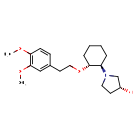
- Mechanism
- Curator reviewed · 3 references
Vernakalant blocks atrial voltage-gated sodium channels in a dose and frequency-dependent manner and inhibits late sodium current (INa)which confers its effect on intra-atrial conduction. This current blockade enhance and onset of drug action accelerates in higher heart rate as the affinity of vernakalant for INa also increases. Its binding offset is quick once the heart rate slows. It also blocks Kv 1.5 channel and its early activating potassium channels (IKur) and inhibits acetylcholine-activated potassium channels (IKAch), which are specific to the atrium and cause prolongation of atrial refractoriness. Vernakalant also blocks Kv4.3 channel and its cardiac transient outward potassium current (Ito), which is involved more with atrial than ventricular refractoriness. Vernakalant minimally blocks hERG channels and its rapidly activating/delayed rectifying potassium current (IKr) which accounts for mild QT prolongation. QRS widening due to INa blockade also contributes to QT prolongation.
- Primary indication
- Indicated for the rapid conversion of recent onset of atrial fibrillation to sinus rhythm in adults for non-surgery patients that lasts for less than 7 days of duration and post-cardiac surgery patients with atrial fibrillation...Curator reviewed · 1 structured indication
- Formula / weight
- C20H31NO4 · 349.471 g/mol (avg)
- First approval
- Canada, 2018 · European Union, 2020
- Brand names
Resolves to
VBHQKCBVWWUUKN-KZNAEPCWSA-NSMILESCOC1=C(OC)C=C(CCO[C@@H]2CCCC[C@H]2N2CC[C@@H](O)C2)C=C1What you can answer from here — as of September 23, 2026
Which drugs share a target with Vernakalant, and which of those have an active Phase 3 trial?
Create a free account or log in to explore the full data card.
Create Account