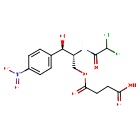
Chloramphenicol succinate is a broad-spectrum antibiotic agent used for the treatment of acute and severe infections caused by susceptible bacterial strains. Use of chloramphenicol succinate and chloramphenicol has decreased due to the risk of potentially fatal blood dyscrasias.
- Mechanism
- Curator reviewed · 3 references
Chloramphenicol succinate is hydrolyzed into the active chloramphenicol. Chloramphenicol resembles uridine-5'-phosphate. It binds to the residues A2451 and A2452 in the 23S rRNA of the 50S ribosomal subunit of E. coli, which prevents translation.
- Primary indication
- Chloramphenicol succinate is indicated to treat serious and susceptible bacterial infections where less dangerous drugs are ineffective or contraindicated.Curator reviewed · 3 structured indications
- Formula / weight
- C15H16Cl2N2O8 · 423.202 g/mol (avg)
- First approval
- Canada, 2022 · United States, 1959
- Also known as
- Chloramphenicol hemisuccinate
Resolves to
LIRCDOVJWUGTMW-ZWNOBZJWSA-NSMILESO[C@@H]([C@@H](COC(=O)CCC(O)=O)NC(=O)C(Cl)Cl)C1=CC=C(C=C1)[N+]([O-])=OWhat you can answer from here — as of August 30, 2026
Which drugs share a target with Chloramphenicol succinate, and which of those have an active Phase 3 trial?
Create a free account or log in to explore the full data card.
Create Account