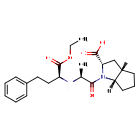
Ramipril is an ACE inhibitor used for the management of hypertension and the reduction of cardiovascular mortality following myocardial infarction in hemodynamically stable patients with clinical signs of congestive heart failure. Ramipril is a prodrug belonging to the angiotensin-converting enzyme (ACE) inhibitor class of medications.
- Mechanism
- Curator reviewed · 4 references
Ramipril inhibits the RAAS system by binding to and inhibiting ACE thereby preventing the conversion of angiotensin I to angiotensin II. As plasma levels of angiotensin II fall, less activation of the G-protein coupled receptors angiotensin receptor I (AT1R) and angiotensin receptor II (AT2R) occurs.
AT1R mediates vasoconstriction, inflammation, fibrosis, and oxidative stress through a variety of signaling pathways. These include Gq coupling to the inositol triphosphate pathway, activation of phospholipases C, A2, and D which contribute to eicosanoid production, activation of Ca2+-dependent and MAP kinases, Gi and G12/13, and eventual activation of the Jak/STAT pathway leading to cell growth and production of extracellular matrix components. AT1R activation also leads to increased activity of membrane-bound NADH/NADPH oxidase which contributes to production of reactive oxygen species. Decreased activation of this receptor mediates the renoprotective, antihypertensive, and cardioprotective effects of ramipril by reducing inflammation and vasoconstriction.
AT2R acts in opposition to the effects of AT1R by activating phosphotyrosine phosphatases which inhibit MAP kinases, inhibiting Ca2+ channel opening, and stimulating cGMP and nitric oxide production leading to vasodilation. These counteracting effects are shared by the Mas receptor which is activated by Ang(1-7), a subtype of angiotensin produced by plasma esterases from AngI or by ACE2 from AngII produced through a secondary pathway by tonin and cathepsin G. Ang(1-7) also activates AT2R although the bulk of its effect is mediated by MasR.
ACE is also responsible for the breakdown of bradykinin. The resulting buildup of bradykinin due to ACE inhibition is thought to mediate the characteristic dry-cough as a side effect of ACE inhibitor medications.
- Primary indication
- For the management of mild to severe hypertension.Curator reviewed · 11 structured indications
- Formula / weight
- C23H32N2O5 · 416.5106 g/mol (avg)
- First approval
- Canada, 2006 · United States, 1991
- Code names
- C09AA05 · HOE 498
- Brand names
Resolves to
HDACQVRGBOVJII-JBDAPHQKSA-NSMILES[H][C@@]12CCC[C@]1([H])N([C@@H](C2)C(O)=O)C(=O)[C@H](C)N[C@@H](CCC1=CC=CC=C1)C(=O)OCCWhat you can answer from here — as of September 23, 2026
Which drugs share a target with Ramipril, and which of those have an active Phase 3 trial?
Create a free account or log in to explore the full data card.
Create Account