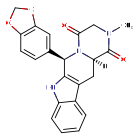
Tadalafil is a phosphodiesterase 5 inhibitor used to treat erectile dysfunction, benign prostatic hyperplasia, and pulmonary arterial hypertension. It was first approved in 2003 by the FDA for use in ED and later in 2009 for PAH.
- Mechanism
- Curator reviewed · 10 references
Tadalafil is a selective phosphodiesterase-5 (PDE5) inhibitor that produces several downstream effects with the most common therapeutic effect being smooth muscle relaxation. Patients may experience ED due to a variety of causes including psychogenic, neurogenic, vasculogenic, iatrogenic, or endocrine. These causes result in dysfunction of penile smooth muscle relaxation through either disrupted neuronal signaling or direct influence on smooth muscle cells. During sexual arousal, non-adrenergic non-cholinergic (NANC) neurons release nitric oxide (NO). Nitric oxide stimulates guanylate cyclase which converts guanosine triphosphate to cyclic guanosine monophosphate (cGMP). cGMP activates the cGMP-dependent kinase (PKG) in a signal cascade which activates K+ channels leading to inhibition of Ca2+ channels, inhibits platelet activation, and inhibits smooth muscle cell proliferation while inducing apoptosis. This signal cascade is attenuated by PDE5 which breaks the phosphodiester bond of cGMP, converting it to GMP. Inhibition of PDE5 by tadalafil increases signaling via the PKG cascade which supports penile smooth muscle relaxation during sexual arousal by decreasing Ca2+ entry into smooth muscle cells. This smooth muscle relaxation allows blood to fill the corpus cavernosum thereby producing an erection.
In PAH, blood pressure in the pulmonary arteries is raised due to a variety of mechanisms stemming from endothelial dysfunction. Decreased production of NO and prostacyclin reduce vasodilatory signaling while overproduction of endothelin-1 and thromboxane increase vasoconstriction. Inflammation, thromboses, and hypoxia later contribute to vascular remodeling which further reduces luminal size. The resultant increase in blood pressure reduces the capacity for gas exchange and increases afterload at the right ventricle, producing symptoms of dyspnea, fatigue, and dizziness as well as leading to right-sided heart failure. Tadalafil exerts its therapeutic effect in PAH through boosting NO-cGMP signaling to contribute to smooth muscle relaxation as with ED.
Lastly, tadalafil is used to treat BPH. BPH produces urinary dysfunction through hyperproliferation of the epithelial and smooth muscle layers of the prostate. The increased size of the prostate blocks urine flow through the urethra resulting in higher residual volumes due to incomplete emptying. Tadalafil does not appear to exert its benefit via smooth muscle relaxation of the prostate. It may instead exert its effect through a mix of increased oxygenation and decreased inflammation, which decreases tissue remodeling, and inhibition of cell proliferation through the cGMP cascade.
The decreased affinity for PDE6 compared to other PDE5 inhibitors may explain the decreased incidence of visual side effects as PDE6 is present in the eye and contributes to color vision.
- Primary indication
- Tadalafil is indicated for the treatment of erectile dysfunction (ED) and either alone or in combination with finasteride for the treatment of benign prostatic hypertrophy (BPH).Curator reviewed · 6 structured indications
- Formula / weight
- C22H19N3O4 · 389.404 g/mol (avg)
- First approval
- Canada, 2007 · United States, 2003 · European Union, 2016
- Code names
- GF 196960 · IC-351 · ICOS 351 · LY450190
- Brand names
Resolves to
WOXKDUGGOYFFRN-IIBYNOLFSA-NSMILES[H][C@]12CC3=C(NC4=CC=CC=C34)[C@H](N1C(=O)CN(C)C2=O)C1=CC2=C(OCO2)C=C1What you can answer from here — as of September 23, 2026
Which drugs share a target with Tadalafil, and which of those have an active Phase 3 trial?
Create a free account or log in to explore the full data card.
Create Account