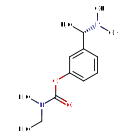
Rivastigmine is a cholinesterase inhibitor used to treat mild to moderate dementia in Alzheimer's and Parkinson's. Rivastigmine is a cholinesterase inhibitor that inhibits both butyrylcholinesterase and acetylcholinesterase.
- Mechanism
- Curator reviewed
Rivastigmine is a carbamate derivative that is structurally related to physostigmine, but not to donepezil and tacrine. The precise mechanism of rivastigmine has not been fully determined, but it is suggested that rivastigmine binds reversibly with and inactivates chlolinesterase (eg. acetylcholinesterase, butyrylcholinesterase), preventing the hydrolysis of acetycholine, and thus leading to an increased concentration of acetylcholine at cholinergic synapses. The anticholinesterase activity of rivastigmine is relatively specific for brain acetylcholinesterase and butyrylcholinesterase compared with those in peripheral tissues.
- Primary indication
- For the treatment of mild to moderate dementia associated with Parkinson's disease or of the Alzheimer's type.Curator reviewed · 5 structured indications
- Formula / weight
- C14H22N2O2 · 250.3367 g/mol (avg)
- First approval
- Canada, 2009 · United States, 2000 · European Union, 2016
- Code names
- ENA-713D · ONO-2540 · SDZ-212-713
- Brand names
Resolves to
XSVMFMHYUFZWBK-NSHDSACASA-NSMILESCCN(C)C(=O)OC1=CC=CC(=C1)[C@H](C)N(C)CWhat you can answer from here — as of September 23, 2026
Which drugs share a target with Rivastigmine, and which of those have an active Phase 3 trial?
Create a free account or log in to explore the full data card.
Create Account