Baclofen is a GABA-ergic agonist used to manage severe spasticity of cerebral or spinal origin in adult and pediatric patients. Baclofen is a gamma-aminobutyric acid (GABA) agonist used as a skeletal muscle relaxant.
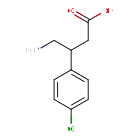
- Mechanism
- Curator reviewed · 3 references
The exact mechanism of action of baclofen is unclear. Baclofen is an agonist at the beta subunit of gamma-aminobutyric acid (GABA) receptors expressed on pre- and post-synaptic neurons. Upon binding to GABAB receptors, baclofen causes an influx of potassium into the neuron, leading to hyperpolarization of the neuronal membrane and decreased calcium influx at presynaptic nerve terminals. This results in a decreased rate of action potential threshold being reached by presynaptic neurons and reduced action potential of postsynaptic motor neurons that innervate the muscle spindles. Baclofen thereby inhibits the transmission of both mono- and polysynaptic reflexes at the spinal cord, relaxing spasticity. Baclofen may act on some voltage-gated calcium channels; however, the clinical significance of this is unclear.
- Primary indication
- Oral baclofen is indicated for the treatment of spasticity resulting from multiple sclerosis and is particularly useful for the relief of flexor spasms and concomitant pain, clonus, and muscular rigidity.Curator reviewed · 9 structured indications
- Formula / weight
- C10H12ClNO2 · 213.661 g/mol (avg)
- First approval
- Canada, 1996 · United States, 1977
- Also known as
- DL-Baclofen
- Brand names
Resolves to
KPYSYYIEGFHWSV-UHFFFAOYSA-NSMILESNCC(CC(O)=O)C1=CC=C(Cl)C=C1What you can answer from here — as of September 20, 2026
Which drugs share a target with Baclofen, and which of those have an active Phase 3 trial?
Create a free account or log in to explore the full data card.
Create Account