Isoniazid is an antibiotic used to treat mycobacterial infections; most commonly use in combination with other antimycobacterial agents for the treatment of active or latent tuberculosis. Antibacterial agent used primarily as a tuberculostatic.
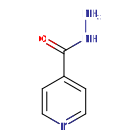
- Mechanism
- Curator reviewed
Isoniazid is a prodrug and must be activated by bacterial catalase. Specficially, activation is associated with reduction of the mycobacterial ferric KatG catalase-peroxidase by hydrazine and reaction with oxygen to form an oxyferrous enzyme complex. Once activated, isoniazid inhibits the synthesis of mycoloic acids, an essential component of the bacterial cell wall. At therapeutic levels isoniazid is bacteriocidal against actively growing intracellular and extracellular Mycobacterium tuberculosis organisms. Specifically isoniazid inhibits InhA, the enoyl reductase from Mycobacterium tuberculosis, by forming a covalent adduct with the NAD cofactor. It is the INH-NAD adduct that acts as a slow, tight-binding competitive inhibitor of InhA.
- Primary indication
- Isoniazid is used for the treatment of all forms of tuberculosis in which organisms are susceptible.Curator reviewed · 4 structured indications
- Formula / weight
- C6H7N3O · 137.1393 g/mol (avg)
- First approval
- Canada, 1997 · United States, 1972
- Also known as
- 4-pyridinecarbohydrazide · Isonicotinic acid hydrazide · Isonicotinic hydrazide · Isonicotinohydrazide · Isonicotinoylhydrazide
- Code names
- NSC-9659
- Brand names
Resolves to
QRXWMOHMRWLFEY-UHFFFAOYSA-NSMILESNNC(=O)C1=CC=NC=C1What you can answer from here — as of September 23, 2026
Which drugs share a target with Isoniazid, and which of those have an active Phase 3 trial?
Create a free account or log in to explore the full data card.
Create Account