Dicoumarol is an oral anticoagulant agent that works by interfering with the metabolism of vitamin K. In addition to its clinical use, it is also used in biochemical experiments as...
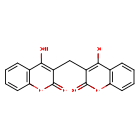
- Mechanism
- Curator reviewed
Dicumarol inhibits vitamin K reductase, resulting in depletion of the reduced form of vitamin K (vitamin KH2). As vitamin K is a cofactor for the carboxylation of glutamate residues on the N-terminal regions of vitamin K-dependent proteins, this limits the gamma-carboxylation and subsequent activation of the vitamin K-dependent coagulant proteins. The synthesis of vitamin K-dependent coagulation factors II, VII, IX, and X and anticoagulant proteins C and S is inhibited. Depression of three of the four vitamin K-dependent coagulation factors (factors II, VII, and X) results in decresed prothrombin levels and a decrease in the amount of thrombin generated and bound to fibrin. This reduces the thrombogenicity of clots.
- Primary indication
- For decreasing blood clotting.Curator reviewed
- Formula / weight
- C19H12O6 · 336.295 g/mol (avg)
- Also known as
- bis-hydroxycoumarin · Dicumarol
- Code names
- NSC-17860 · NSC-221570 · NSC-41834
Resolves to
DOBMPNYZJYQDGZ-UHFFFAOYSA-NSMILESOC1=C(CC2=C(O)C3=C(OC2=O)C=CC=C3)C(=O)OC2=C1C=CC=C2What you can answer from here — as of September 23, 2026
Which drugs share a target with Dicoumarol, and which of those have an active Phase 3 trial?
Create a free account or log in to explore the full data card.
Create Account