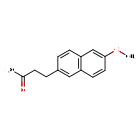
Nabumetone is an NSAID used to treat osteoarthritis and rheumatoid arthritis. Nabumetone was originally developed as a non-acidic non-steroidal anti-inflammatory drug (NSAID).
- Mechanism
- Curator reviewed · 10 references
Nabumetone's active metabolite, 6-MNA, is an inhibitor of both COX-1 and COX-2 although it exhibits some COX-2 selectivity. Inhibition of COX-1 and COX-2 reduces conversion of arachidonic acid to PGs and thromboxane (TXA2). This reduction in prostanoid production is the common mechanism that mediates the effects of nambutone.
PGE2 is the primary PG involved in modulation of nociception. It mediates peripheral sensitization through a variety of effects. PGE2 activates the Gq-coupled EP1 receptor leading to increased activity of the inositol trisphosphate/phospholipase C pathway. Activation of this pathway releases intracellular stores of calcium which directly reduces action potential threshold and activates protein kinase C (PKC) which contributes to several indirect mechanisms. PGE2 also activates the EP4 receptor, coupled to Gs, which activates the adenylyl cyclase/protein kinase A (AC/PKA) signaling pathway. PKA and PKC both contribute to the potentiation of transient receptor potential cation channel subfamily V member 1 (TRPV1) potentiation, which increases sensitivity to heat stimuli. They also activate tetrodotoxin-resistant sodium channels and inhibit inward potassium currents. PKA further contributes to the activation of the P2X3 purine receptor and sensitization of T-type calcium channels. The activation and sensitization of depolarizing ion channels and inhibition of inward potassium currents serve to reduce the intensity of stimulus necessary to generate action potentials in nociceptive sensory afferents. PGE2 act via EP3 to increase sensitivity to bradykinin and via EP2 to further increase heat sensitivity. Central sensitization occurs in the dorsal horn of the spinal cord and is mediated by the EP2 receptor which couples to Gs. Pre-synaptically, this receptor increases the release of pro-nociceptive neurotransmitters glutamate, CGRP, and substance P. Post-synaptically it increases the activity of AMPA and NMDA receptors and produces inhibition of inhibitory glycinergic neurons. Together these lead to a reduced threshold of activating, allowing low intensity stimuli to generate pain signals. PGI2 is known to play a role via its Gs-coupled IP receptor although the magnitude of its contribution varies. It has been proposed to be of greater importance in painful inflammatory conditions such as arthritis. By limiting sensitization, both peripheral and central, via these pathways NSAIDs can effectively reduce inflammatory pain.
PGI2 and PGE2 contribute to acute inflammation via their IP and EP2 receptors. Similarly to β adrenergic receptors these are Gs-coupled and mediate vasodilation through the AC/PKA pathway. PGE2 also contributes by increasing leukocyte adhesion to the endothelium and attracts the cells to the site of injury. PGD2 plays a role in the activation of endothelial cell release of cytokines through its DP1 receptor. PGI2 and PGE2 modulate T-helper cell activation and differentiation through IP, EP2, and EP4 receptors which is believed to be an important activity in the pathology of arthritic conditions. By limiting the production of these PGs at the site of injury, NSAIDs can reduce inflammation.
PGE2 can cross the blood-brain barrier and act on excitatory Gq EP3 receptors on thermoregulatory neurons in the hypothalamus. This activation triggers an increase in heat-generation and a reduction in heat-loss to produce a fever. NSAIDs prevent the generation of PGE2 thereby reducing the activity of these neurons.
The adverse effects of NSAIDs stem from the protective and regulatory roles of prostanoids which have been well-characterized. PGI2 and PGE2 regulate blood flow to the kidney by similar mechanisms to the vasodilation they produce in inflammation. Prevention of this regulation by NSAIDs produces vasoconstriction which limits renal function by reducing blood flow and the hydrostatic pressure which drives filtration. PGE2 also regulates gastric protection via EP3 receptors which are, in this location, coupled to Gi which inhibits the AC/PKA pathway. This reduces the secretion of protons by H+/K+ ATPase in parietal cells and increases the secretion of mucus and HCO3- by superficial endothelial cells. Disruption of this protective action by NSAIDs lead to ulceration of the gastric mucosa. Lastly, disruption of PGI2, which opposes platelet aggregation, generation by COX-2 selective agents leads to an imbalance with TXA2 generated by COX-1, which promotes aggregation of platelets, leading to increased risk of thrombosis. Since nabumetone is somewhat COX-2 selective it is thought to promote this imbalance and increase thrombotic risk.
- Primary indication
- Indicated for: 1) Symptomatic relief in rheumatoid arthritis.Curator reviewed · 2 structured indications
- Formula / weight
- C15H16O2 · 228.2863 g/mol (avg)
- First approval
- Canada, 1998 · United States, 2001
- Code names
- BRL-14777
- Brand names
Resolves to
BLXXJMDCKKHMKV-UHFFFAOYSA-NSMILESCOC1=CC2=C(C=C1)C=C(CCC(C)=O)C=C2What you can answer from here — as of September 23, 2026
Which drugs share a target with Nabumetone, and which of those have an active Phase 3 trial?
Create a free account or log in to explore the full data card.
Create Account