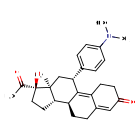
Ulipristal is a selective progesterone receptor modulator used for emergency contraception after unprotected intercourse or in a situation where a planned method of contraception has failed. It is a derivative of 19-norprogesterone and has both antagonistic and partial agonist activity at the progesterone receptor.
- Mechanism
- Curator reviewed · 26 references
The exact mechanism of action of ulipristal has been heavily debated. On one hand, the majority of official prescribing information labels, monographs, and prior research studies for ulipristal indicated as an emergency contraceptive suggest that its primary mechanism of action revolves around inhibiting or delaying ovulation by suppressing surges in LH that result in the postponement of follicular rupture.
Conversely, some of the latest investigations pertaining to ulipristal's mechanism of action as an emergency contraceptive propose that it principally elicits its action by preventing embryo implantation, as opposed to preventing ovulation. Although previous investigations have shown that ulipristal essentially has the ability to prevent ovulation equivalent to placebo (ie. null effect or ability) when administered during LH peaks one to two days before ovulation, the agent still demonstrates a stable and consistently high contraceptive effect of approximately >=80% when used at this time. Subsequently, current studies attempt to investigate how ulipristal could elicit emergency contraception via ovulation prevention under circumstances where ovulation had already clearly been observed. Endometrial biopsy samples studied from such circumstances in such investigations subsequently show that the administered ulipristal causes endometrial tissue to become inhospitable and unsuitable for embryo implantation where a variety of genes characteristic of receptive, pro-gestational endometrium are downregulated.
Nevertheless, most if not all proposed mechanisms commonly agree that ulipristal ultimately demonstrates its pharmacological effects by binding to human progesterone receptors and prevents natural, endogenous progesterone from occupying such receptors. Regardless, however, considering current and on-going research into ulipristal's ability to prevent embryo implantation, the notion that the medication can elicit post-fertilization effects potentially raises alerts and/or ethical debates over the use of ulipristal owing to potential abortifacient activity, which is considered to be on par or equipotent to that of mifepristone. Attention should be drawn to the fact that some prescribing information, however, such as the US FDA label for ulipristal indicated for emergency contraception, has included new supplementary commentary since 2018 that directly warns about ulipristal not being indicated for termination of existing pregnancies and suggesting that ulipristal use may confer alterations to the endometrium that may affect implantation and contribute to efficacy.
In the treatment of fibroids, ulipristal has been shown to exert direct actions on fibroids reducing their size through inhibition of cell proliferation and induction of apoptosis.
- Primary indication
- Ulipristal is an emergency contraceptive indicated for prevention of pregnancy following unprotected intercourse or a known or suspected contraceptive failure.Curator reviewed · 2 structured indications
- Formula / weight
- C28H35NO3 · 433.592 g/mol (avg)
- First approval
- Canada, 2015 · United States, 2010 · European Union, 2016
- Code names
- CDB-2914
- Brand names
Resolves to
HKDLNTKNLJPAIY-WKWWZUSTSA-NSMILESCN(C)C1=CC=C(C=C1)[C@H]1C[C@@]2(C)[C@@H](CC[C@]2(O)C(C)=O)[C@@H]2CCC3=CC(=O)CCC3=C12What you can answer from here — as of September 23, 2026
Which drugs share a target with Ulipristal, and which of those have an active Phase 3 trial?
Create a free account or log in to explore the full data card.
Create Account