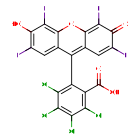
Rose bengal is a pink stain derived as an analogue of fluorescein. Its disodium salt in ophthalmic solutions has been used as a diagnostic agent in suspected damage to conjunctival... It is also used in laboratory settings, including the preparation of Foraminifera for microscopic analysis and suppression of bacterial growth in several microbiological media.
- Mechanism
- Curator reviewed · 3 references
Rose Bengal stains both the nuclei and cell walls of dead or degenerated epithelial cells of the cornea and conjunctiva, and stain the mucus of the precorneal tear film. It is proposed that the staining ability of rose bengal is dependent on the status of tear film protection rather than cell viability, as tear components such as albumin and mucin can block the rose bengal uptake. It induces intrinsic cytotoxic effects by causing cellular morphologic changes, subsequent loss of cellular motility, cell detachment, and cell death. It mediates inhibitory actions on bovine corneal endothelial cells and attenuates cell proliferation.
- Primary indication
- Indicated as a diagnostic agent in routine ocular examinations or when superficial conjunctiva or corneal tissue change is suspected, and as an aid in the diagnosis of keratoconjunctivitis sicca, keratitis, abrasions or corrosions as well...Curator reviewed
- Formula / weight
- C20H4Cl4I4O5 · 973.673 g/mol (avg)
- First approval
- Canada, 2015
Resolves to
VDNLFJGJEQUWRB-UHFFFAOYSA-NSMILESOC(=O)C1=C(Cl)C(Cl)=C(Cl)C(Cl)=C1C1=C2C=C(I)C(=O)C(I)=C2OC2=C(I)C(O)=C(I)C=C12What you can answer from here — as of September 23, 2026
Which drugs share a target with Rose bengal, and which of those have an active Phase 3 trial?
Create a free account or log in to explore the full data card.
Create Account