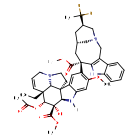
Vinflunine is a vinca alkaloid used to treat advanced or metastatic transitional cell carcinoma of the urothelial tract after a platinum containing treatment has failed. Vinflunine is a third-generation member of the vinca alkaloid family with anti-tumour actions.
- Mechanism
- Curator reviewed · 8 references
Microtubules are a major component of the cytoskeleton that have a critical role in maintenance of cell shape, mobility, adhesion and intracellular integrity. They also play a role in the formation of the mitotic spindle and chromosomal segregation to the daughter cells at mitosis. Via GTP hydrolysis at the β-tubulin subunit and polymerization of tubulin into linear polymers, microtubules, or macromolecular filaments composed of tubulin heterodimers, are formed via a mechanism of nucleation-elongation. At the onset of mitosis, the interphase microtubule network disassembles into the tubulin. The tubulin reassembles into a new population of mitotic spindle microtubules that further undergo rapid successions of lengthening and shortening until they are attached to the newly duplicated sister chromatids at their centromeres. The dynamic behaviour of microtubules are characterized by two mechanical process: dynamic instability indicating repeated switches of growth and shortening at the ends, and microtubule treadmilling that involves the fast-growing (+) end of the microtubule accompanied by a net loss of the opposite slow-growing (-) end. Microtubule treadmilling plays a critical role in mitosis by generating the forces for separation of the chromosomes in the mitotic spindle from centrosome and kinetochores.
In both cancer and normal cells, vinflunine binds to tubulin at or near to the vinca binding sites at β-tubulin. It is proposed that in similarity to other vinca alkaloids, vinflunine is most likely to bind to β-tubulin subunit at the interdimer interface. Via direct binding to tubulin, vinflunine inhibits microtubule polymerization and induces a G2+M arrest, or a mitotic arrest. Vinflunine disrupts the dynamic function of microtubules by suppressing treadmilling and slowing the microtubule growth rate while increasing growth duration. Ultimately, mitotic accumulation at the metaphase/anaphase transition results in cell apoptosis.
- Primary indication
- For use as a monotherapy in adults with advanced or transitional cell carcinoma of the urothelial tract after failure of a prior platinum-containing therapy.Curator reviewed · 2 structured indications
- Formula / weight
- C45H54F2N4O8 · 816.944 g/mol (avg)
- First approval
- European Union, 2016
- Brand names
Resolves to
NMDYYWFGPIMTKO-KLCPSUAYSA-NSMILESCC[C@@]12C=CCN3CC[C@@]4([C@H]13)[C@@H](N(C)C1=CC(OC)=C(C=C41)[C@]1(C[C@@H]3C[C@H](C[N@@](C3)CC3=C1NC1=CC=CC=C31)C(C)(F)F)C(=O)OC)[C@](O)([C@@H]2OC(C)=O)C(=O)OCWhat you can answer from here — as of September 23, 2026
Which drugs share a target with Vinflunine, and which of those have an active Phase 3 trial?
Create a free account or log in to explore the full data card.
Create Account