Etripamil is an L-type calcium channel blocker used to convert acute symptomatic episodes of paroxysmal supraventricular tachycardia to sinus rhythm in adults. It is a fast-acting drug with a short duration of action.
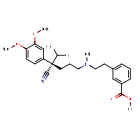
- Mechanism
- Curator reviewed · 8 references
Etripamil is a novel, short-acting, nondihydropyridine L-type calcium channel blocker formulated for intranasal administration. It exerts its anti-arrhythmic effect by inhibiting voltage-dependent L-type calcium channels (Cav1.2 and Cav1.3), which are critical for mediating calcium entry into cardiac myocytes and regulating excitation-contraction coupling and nodal conduction. Specifically, etripamil targets the L-type calcium channels expressed on atrioventricular (AV) nodal cells, arterial smooth muscles, and contractile myocardial cells. By blocking calcium influx, the drug prolongs the refractory period and slows electrical conduction through the AV node, thereby interrupting the re-entrant circuits responsible for AV-nodal dependent paroxysmal supraventricular tachycardia (PSVT) and facilitating the restoration of sinus rhythm.
- Primary indication
- Etripamil is indicated for the conversion of acute symptomatic episodes of paroxysmal supraventricular tachycardia (PSVT) to sinus rhythm in adults.Curator reviewed · 1 structured indication
- Formula / weight
- C27H36N2O4 · 452.595 g/mol (avg)
- First approval
- United States, 2026
- Also known as
- Benzoic acid, 3-[2-[[(4S)-4-cyano-4-(3,4-dimethoxyphenyl)-5-methylhexyl]methylamino]ethyl]-, methyl ester · Methyl 3-[2-[[(4S)-4-cyano-4-(3,4-dimethoxyphenyl)-5-methylhexyl]methylamino]ethyl]benzoate
- Code names
- MSP-2017
- Brand names
Resolves to
VAZNEHLGJGSQEL-MHZLTWQESA-NSMILESCOC(=O)C1=CC(CCN(C)CCC[C@](C#N)(C(C)C)C2=CC=C(OC)C(OC)=C2)=CC=C1What you can answer from here — as of August 31, 2026
Which other approved drugs treat the same conditions as Etripamil, and which companies have late-stage candidates in those indications?
Create a free account or log in to explore the full data card.
Create Account