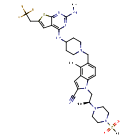
Ziftomenib is a menin inhibitor used to treat acute myeloid leukemia with NPM1 mutations. This drug was approved by the FDA on November 13th, 2025, for the treatment of relapsed or refractory acute myeloid leukemia (AML) in adults with a susceptible NPM1 mutation who have no satisfactory alternative treatment...
- Mechanism
- Curator reviewed · 16 references
Ziftomenib is a potent and selective inhibitor of menin, a nuclear protein that serves as a critical cofactor in transcriptional regulation. The drug is indicated for the treatment of acute myeloid leukemia (AML), specifically targeting subtypes driven by nucleophosmin 1 (NPM1) mutations or lysine methyltransferase 2A (KMT2A) rearrangements. These genetic alterations are foundational drivers of leukemogenesis; for instance, NPM1 mutations lead to the recruitment of the wild-type menin-KMT2A complex to promoters of leukemogenic genes, causing their aberrant upregulation. Ziftomenib functions by blocking the protein-protein interaction between menin and KMT2A, a complex essential for maintaining the proliferation and survival of these leukemic cells.
At the molecular level, ziftomenib binds to menin at the KMT2A interaction site with high potency, effectively displacing KMT2A and disrupting the chromatin-associated complex. In NPM1-mutant AML, this disruption disengages the mutant NPM1 protein from chromatin sites. The breakdown of this interaction leads to the rapid downregulation of critical downstream leukemogenic transcription factors, specifically HOXA9 and MEIS1. These genes are typically upregulated in these AML subtypes and are responsible for blocking cellular differentiation and driving leukemic growth. The inhibition of the menin-KMT2A interaction and the subsequent suppression of HOXA9 and MEIS1 expression result in the reversal of the leukemic block on differentiation. Consequently, ziftomenib induces terminal differentiation of leukemic blasts, which is evidenced by the increased expression of differentiation markers and a reduction in leukemic burden. Nonclinical and clinical studies have confirmed that this mechanism yields potent anti-leukemic activity in models of both NPM1-mutant and KMT2A-rearranged leukemia.
- Primary indication
- Ziftomenib is indicated for the treatment of adult patients with relapsed or refractory acute myeloid leukemia (AML) with a susceptible nucleophosmin 1 (NPM1) mutation who have no satisfactory alternative treatment options.Curator reviewed · 2 structured indications
- Formula / weight
- C33H42F3N9O2S2 · 717.88 g/mol (avg)
- First approval
- United States, 2025
- Also known as
- (s)-4-methyl-5-((4-((2-(methylamino)-6-(2,2,2-trifluoroethyl)thieno(2,3-d)pyrimidin-4-yl)amino)piperidin-1-yl)methyl)-1-(2-(4-(methylsulfonyl)piperazin-1-yl)propyl)-1h-indole-2-carbonitrile · (S)-4-methyl-5-((4-((2-(methylamino)-6-(2,2,2-trifluoroethyl)thieno[2,3- d]pyrimidin-4-yl)amino)piperidin-1-yl)methyl)-1-(2-(4-(methylsulfonyl)piperazin-1-yl)propyl)-1Hindole-2-carbonitrile · 1h-indole-2-carbonitrile, 4-methyl-5-((4-((2-(methylamino)-6-(2,2,2-trifluoroethyl)thieno(2,3-d)pyrimidin-4-yl)amino)-1-piperidinyl)methyl)-1-((2s)-2-(4-(methylsulfonyl)-1-piperazinyl)propyl)- · Menin-mll interaction inhibitor ko 539
- Code names
- KO-539
- Brand names
Resolves to
BGGALFIXXQOTPY-NRFANRHFSA-NSMILESCNC1=NC(NC2CCN(CC3=CC=C4N(C[C@H](C)N5CCN(CC5)S(C)(=O)=O)C(=CC4=C3C)C#N)CC2)=C2C=C(CC(F)(F)F)SC2=N1What you can answer from here — as of September 23, 2026
Which drugs share a target with Ziftomenib, and which of those have an active Phase 3 trial?
Create a free account or log in to explore the full data card.
Create Account