Rilzabrutinib is a kinase inhibitor used to treat persistent or chronic immune thrombocytopenia (ITP) who have had an insufficient response to a previous treatment. ITP is an autoimmune disorder characterized by low platelet count.
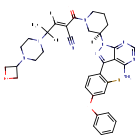
- Mechanism
- Curator reviewed · 13 references
Immune thrombocytopenia (ITP) is an autoimmune disorder characterized by a low platelet count, bruising, and bleeding events. It results from a complex dysregulation of the immune system that leads to both increased destruction of circulating platelets and impaired platelet production. One primary mechanism involves the production of autoantibodies, typically of the IgG class, which bind to glycoproteins on the surface of platelets. This binding marks the platelets for clearance, primarily through phagocytosis by macrophages in the spleen and liver. This process is mediated by the binding of the Fc portion of the autoantibodies to Fcγ receptors (FcγR) on macrophages. Another key pathway involves the role of Bruton's tyrosine kinase (BTK), an intracellular signalling molecule expressed in various immune cells, including B cells, macrophages, and mast cells. In ITP, BTK signalling contributes to the production of anti-platelet autoantibodies by B cells and to the FcγR-mediated destruction of platelets by macrophages.
Through reversible and covalent inhibition of BTK, rilzabrutinib inhibits B cell activation and interrupts antibody-coated cell phagocytosis by Fcγ receptor (FcγR) in spleen and liver. In vitro, rilzabrutinib reduced autoantibody signaling mediated through the FcγR pathway, blocked B cell signaling, and decreased autoantibody generation through effects on B cell activation.
- Primary indication
- Rilzabrutinib is indicated for the treatment of adult patients with persistent or chronic immune thrombocytopenia (ITP) who have had an insufficient response to a previous treatment.Curator reviewed · 2 structured indications
- Formula / weight
- C36H40FN9O3 · 665.774 g/mol (avg)
- First approval
- United States, 2025 · European Union, 2026
- Also known as
- (3R)-3-[4-Amino-3-(2-fluoro-4-phenoxyphenyl)-1H-pyrazolo[3,4-d]pyrimidin-1-yl]-?-[2-methyl-2-[4-(3-oxetanyl)-1-piperazinyl]propylidene]-?-oxo-1-piperidinepropanenitrile · (e/z)-(r)-2-(3-(4-amino-3-(2-fluoro-4-phenoxyphenyl)-1h-pyrazolo(3,4-d)pyrimidin-1-yl)piperidine-1-carbonyl)-4-methyl-4-(4-(oxetan-3-yl)piperazin-1-yl)pent-2-enenitrile · 1-piperidinepropanenitrile, 3-(4-amino-3-(2-fluoro-4-phenoxyphenyl)-1h-pyrazolo(3,4-d)pyrimidin-1-yl)-.alpha.-(2-methyl-2-(4-(3-oxetanyl)-1-piperazinyl)propylidene)-.beta.-oxo-, (.alpha.e/z,3r)-
- Code names
- PRN-1008 · SAR444671
- Brand names
Resolves to
LCFFREMLXLZNHE-GBOLQPHISA-NSMILES[H]\C(=C(\C#N)C(=O)N1CCC[C@]([H])(C1)N1N=C(C2=C(N)N=CN=C12)C1=C(F)C=C(OC2=CC=CC=C2)C=C1)C(C)(C)N1CCN(CC1)C1COC1What you can answer from here — as of September 23, 2026
Which drugs share a target with Rilzabrutinib, and which of those have an active Phase 3 trial?
Create a free account or log in to explore the full data card.
Create Account