Warfarin is a vitamin K antagonist used to treat venous thromboembolism, pulmonary embolism, thromboembolism with atrial fibrillation, thromboembolism with cardiac valve replacement, and thromboembolic events post myocardial infarction. Warfarin is an anticoagulant drug normally used to prevent blood clot formation as well as migration.
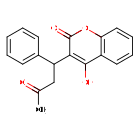
- Mechanism
- Curator reviewed · 3 references
Warfarin is a [vitamin K] antagonist which acts to inhibit the production of vitamin K by vitamin K epoxide reductase. The reduced form of vitamin K, vitamin KH2 is a cofactor used in the γ-carboxylation of coagulation factors VII, IX, X, and thrombin. Carboxylation induces a conformational change allowing the factors to bind Ca2+ and to phospholipid surfaces. Uncarboxylated factors VII, IX, X, and thrombin are biologically inactive and therefore serve to interrupt the coagulation cascade. The endogenous anticoagulation proteins C and S also require γ-carboxylation to function. This is particularly true in the case of thrombin which must be activated in order to form a thrombus. vitamin KH2 is converted to vitamin K epoxide as part of the γ-carboxylation reaction catalyzed by γ-glutamyl carboxylase. Vitamin K epoxide is then converted to vitamin K1 by vitamin K epoxide reductase then back to vitamin KH2 by vitamin K reductase. Warfarin binds to vitamin K epoxide reductase complex subunit 1 and irreversibly inhibits the enzyme thereby stopping the recycling of vitamin K by preventing the conversion of vitamin K epoxide to vitamin K1. This process creates a hypercoagulable state for a short time as proteins C and S degrade first with half lives of 8 and 24 hours, with the exception of factor VII which has a half life of 6 hours. Factors IX, X, and finally thrombin degrade later with half lives of 24, 36, and 50 hours resulting in a dominant anticoagulation effect. In order to reverse this anticoagulation vitamin K must be supplied, either exogenously or by removal of the vitamin K epoxide reductase inhibition, and time allowed for new coagulation factors to be synthesized. It takes approximately 2 days for new coagulation factors to be synthesized in the liver. Vitamin K2, functionally identical to vitamin K1, is synthesized by gut bacteria leading to interactions with antibiotics as elimination of these bacteria can reduce vitamin K2
- Primary indication
- Indicated for: 1) Prophylaxis and treatment of venous thromboembolism and related pulmonary embolism.Curator reviewed · 13 structured indications
- Formula / weight
- C19H16O4 · 308.3279 g/mol (avg)
- First approval
- Canada, 2000 · United States, 1995
- Also known as
- Zoocoumarin
- Brand names
Resolves to
PJVWKTKQMONHTI-UHFFFAOYSA-NSMILESCC(=O)CC(C1=CC=CC=C1)C1=C(O)C2=C(OC1=O)C=CC=C2What you can answer from here — as of September 23, 2026
Which drugs share a target with Warfarin, and which of those have an active Phase 3 trial?
Create a free account or log in to explore the full data card.
Create Account