Oxycodone is an opioid used in the management of moderate to severe pain. Oxycodone is a semisynthetic opioid analgesic derived from thebaine in Germany in 1917.
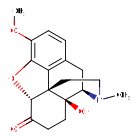
- Mechanism
- Curator reviewed · 5 references
The full mechanism of oxycodone is not known. Under conditions of inflammation or hyperalgesia, opioid receptors in the heart, lungs, liver, gastrointestinal tract, and reproductive system are upregulated and transported to nerve terminals. Oxycodone and its active metabolites, noroxycodone, oxymorphone, and noroxymorphone are opioid agonists. These compounds passively diffuse across the blood brain barrier or may be actively transported across by an unknown mechanism. Oxycodone and its active metabolites can selectively bind to the mu opioid receptor, but also the kappa and delta opioid receptors in the central nervous system and periphery, and induce a G protein coupled receptor signalling pathway. Activation of mu opioid receptors inhibits N-type voltage operated calcium channels, inhibiting responses to pain.
- Primary indication
- Oxycodone is indicated for the treatment of moderate to severe pain.Curator reviewed · 6 structured indications
- Formula / weight
- C18H21NO4 · 315.3636 g/mol (avg)
- First approval
- Canada, 1997 · United States, 1950
- Also known as
- Dihydrohydroxycodeinone · Dihydroxycodeinone
- Code names
- IDS-NO-002 · N02AA05 · NSC-19043 · PF-00345439 · PTI-821
- Brand names
Resolves to
BRUQQQPBMZOVGD-XFKAJCMBSA-NSMILESCOC1=C2O[C@H]3C(=O)CC[C@@]4(O)[C@H]5CC(C=C1)=C2[C@@]34CCN5CWhat you can answer from here — as of September 23, 2026
Which drugs share a target with Oxycodone, and which of those have an active Phase 3 trial?
Create a free account or log in to explore the full data card.
Create Account