Fentanyl is an opioid analgesic used in anesthesia, for breakthrough cancer pain, or round the clock pain management. Fentanyl, a potent opioid agonist, was developed in the 1950s to fill a need for strong and rapid analgesia.
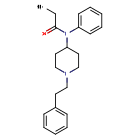
- Mechanism
- Curator reviewed · 4 references
Fentanyl binds to opioid receptors, especially the mu opioid receptor, which are coupled to G-proteins. Activation of opioid receptors causes GTP to be exchanged for GDP on the G-proteins which in turn down regulates adenylate cyclase, reducing concentrations of cAMP. Reduced cAMP decreases cAMP dependant influx of calcium ions into the cell. The exchange of GTP for GDP results in hyperpolarization of the cell and inhibition of nerve activity.
- Primary indication
- Fentanyl intravenous or intramuscular injections are indicated for short term analgesia during induction, maintenance, and recovery from general or regional anesthesia.Curator reviewed · 11 structured indications
- Formula / weight
- C22H28N2O · 336.4705 g/mol (avg)
- First approval
- Canada, 1997 · United States, 1984 · European Union, 2016
- Also known as
- Fentanil · Fentanyl CII · N-phenyl-N-[1-(2-phenylethyl)-4-piperidinyl]propanamide · Phentanyl
- Code names
- AD-923 · EN3267 · IDS-NF-001 · McN-JR 4263-49 · R 4263 · R 5240
- Brand names
Resolves to
PJMPHNIQZUBGLI-UHFFFAOYSA-NSMILESCCC(=O)N(C1CCN(CCC2=CC=CC=C2)CC1)C1=CC=CC=C1What you can answer from here — as of September 13, 2026
Which drugs share a target with Fentanyl, and which of those have an active Phase 3 trial?
Create a free account or log in to explore the full data card.
Create Account