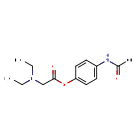
Propacetamol is a non-opioid analgesic devoid of the major contraindications. It is a derivative of acetaminophen, or paracetamol, with the molecular formula glycine, N, N-diethyl-,4-(acetylamino)phenyl ester. Propacetamol is a parenteral... Propacetamol is a parenteral formulation of paracetamol and thus, it is a prodrug that is completely hydrolyzed to paracetamol.
- Mechanism
- Curator reviewed · 4 references
As propacetamol is a prodrug, its mechanism of action is directly linked to the activity of paracetamol. The mechanism of action of paracetamol is described by the inhibition of prostaglandin synthesis. This inhibition is attained by inhibition of COX-1 and COX-2 in an environment where arachidonic acid and peroxides are kept low. It is considered that paracetamol presents a very complex mechanism of action involving effects in the peripheral system, described by direct COX inhibition; the central system, characterized by inhibition of COX, serotonergic descending neuronal pathway, L-arginine/NO pathway and cannabinoid system; and a redox mechanism. In the brain and spinal cord, paracetamol can combine with arachidonic acid to form N-arachidonoylphenolamine. This metabolite is an activator of capsaicin receptor (TRPV1) and cannabinoid CB1.
- Primary indication
- Propacetamol is a paracetamol prodrug of intravenous administration used to control fever and pain of perioperative period in multimodal analgesia therapy.Curator reviewed
- Formula / weight
- C14H20N2O3 · 264.325 g/mol (avg)
Resolves to
QTGAJCQTLIRCFL-UHFFFAOYSA-NSMILESCCN(CC)CC(=O)OC1=CC=C(NC(C)=O)C=C1What you can answer from here — as of August 30, 2026
Which drugs share a target with Propacetamol, and which of those have an active Phase 3 trial?
Create a free account or log in to explore the full data card.
Create Account