Duloxetine is a serotonin norepinephrine reuptake inhibitor used to treat generalized anxiety disorder, neuropathic pain, osteoarthritis, and stress incontinence. It was originally discovered in 1993 and developed by Eli Lilly and Company as LY248686.
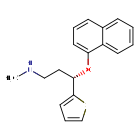
- Mechanism
- Curator reviewed · 9 references
Duloxetine is a potent inhibitor of neuronal serotonin and norepinephrine reuptake and a less potent inhibitor of dopamine reuptake. Duloxetine has no significant affinity for dopaminergic, adrenergic, cholinergic, histaminergic, opioid, glutamate, and GABA receptors.
Action on the external urinary sphincter is mediated via duloxetine's CNS effects. Increased serotonin and norepinephrine concentrations in Onuf's nucleus leads to increased activation of 5-HT2, 5-HT3, and α1 adrenergic receptors. 5-HT2 and α1 are both Gq coupled and their activation increases the activity of the inositol trisphosphate/phospholipase C (IP3/PLC) pathway. This pathway leads to release of intracellular calcium stores, increasing intracellular calcium concentrations, and facilitating neuronal excitability. 5-HT3 functions as a ligand-gated sodium channel which allows sodium to flow into the neuron when activated. Increased flow of sodium into the neuron contributes to depolarization and activation of voltage gated channels involved in action potential generation. The combined action of these three receptors contributes to increased excitability of the pudendal motor nerve in response to glutamate.
Also related to duloxetine's action at the spinal cord is its modulation of pain. Increasing the concentration of serotonin and norepinephrine in the dorsal horn of the spinal cord increases descending inhibition of pain through activation of 5-HT1A, 5-HT1B, 5-HT1D, 5-HT2, 5-HT3, α1-adrenergic, and α2-adrenergic receptors. 5-HT2, 5-HT3, and α1-adrenergic mediate neuronal activation as described above. The activated neuron in this case is the GABAergic inhibitory interneuron which synapses onto the nociceptive projection neuron to inhibit the transmission of painful stimuli to the brain. The 5-HT1 and α2 receptors are Gi/Go coupled and their activation leads to increased potassium current through inward rectifier channels and decreased adenylyl cyclase/protein kinase A signaling which contributes to neuronal inhibition. These inhibitory receptors are present on the projection neuron itself as well as the dorsal root ganglion which precedes it and serves to directly suppress the transmission of painful stimuli.
The mechanisms involved in duloxetine's benefits in depression and anxiety have not been fully elucidated. Dysfunctional serotonin and norepinephrine signaling are thought to be involved and increases in the availability of these neurotransmitters at the synaptic cleft thought to mediate a therapeutic effect. It is postulated that the involvement of serotonin and norepinephrine in area responsible for emotional modulation such as the limbic system contributes to the effects in mood disorders specifically but this has yet to be confirmed.
Duloxetine's hypertensive effect is related to its intended pharmacological effect. Increased availability of norepinephrine leads to activation of adrenergic receptors on the vascular endothelium. Since the action of α1 receptors predominates, vasoconstriction results as the Gq coupled receptor mediates calcium release from the sarcoplasmic reticulum to facilitate smooth muscle contraction.
- Primary indication
- Indicated for: 1) Management of Major Depressive Disorder.Curator reviewed · 8 structured indications
- Formula / weight
- C18H19NOS · 297.415 g/mol (avg)
- First approval
- Canada, 2007 · United States, 2004 · European Union, 2016
- Also known as
- (S)-duloxetine
- Code names
- LY-248686
- Brand names
Resolves to
ZEUITGRIYCTCEM-KRWDZBQOSA-NSMILESCNCC[C@H](OC1=CC=CC2=CC=CC=C12)C1=CC=CS1What you can answer from here — as of September 23, 2026
Which drugs share a target with Duloxetine, and which of those have an active Phase 3 trial?
Create a free account or log in to explore the full data card.
Create Account