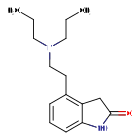
Ropinirole is a non-ergoline dopamine agonist used to treat the symptoms of Parkinson's disease and Restless Legs Syndrome. It is manufactured by GlaxoSmithKline Pharmaceuticals.
- Mechanism
- Curator reviewed · 2 references
Ropinirole is a non-ergoline dopamine agonist. Ropinirole has the highest affinity at the D3 receptors, which are concentrated in the limbic areas of the brain and may be responsible for some of the neuropsychiatric effects. The exact mechanism of action of ropinirole as a treatment for Parkinson’s disease is unknown, however, it is believed to be related to its ability to selectively stimulate dopamine D2 receptors within the caudate-putamen system in the brain. This system affects body movement. Negligible affinity is seen for ropinirole at α2 adrenoreceptors in the periphery and 5HT-1 receptor. Ropinirole has no affinity at the D1-like receptors, benzodiazepine or GABA receptors.
The precise mechanism of action of ropinirole as a treatment for Restless Legs Syndrome is unknown, however, it is believed to be related to its ability to stimulate dopamine receptors.
- Primary indication
- For the treatment of the signs and symptoms of Parkinson's disease and for the treatment of primary moderate-severe restless legs syndrome.Curator reviewed · 5 structured indications
- Formula / weight
- C16H24N2O · 260.3746 g/mol (avg)
- First approval
- Canada, 2001 · United States, 1997
- Code names
- SK&F-101468
- Brand names
Resolves to
UHSKFQJFRQCDBE-UHFFFAOYSA-NSMILESCCCN(CCC)CCC1=C2CC(=O)NC2=CC=C1What you can answer from here — as of September 23, 2026
Which drugs share a target with Ropinirole, and which of those have an active Phase 3 trial?
Create a free account or log in to explore the full data card.
Create Account