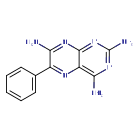
Triamterene is a potassium-sparing diuretic used in the treatment of edema and in the management of hypertension. It works by promoting the excretion of sodium ions and water while decreasing the potassium excretion in the distal part of the nephron in the kidneys by working on the lumenal side.
- Mechanism
- Curator reviewed · 10 references
Triamterene inhibits the epithelial sodium channels (ENaC) located on the lumenal side in the late distal convoluted tubule and collecting tubule, which are transmembrane channels that normally promote sodium uptake and potassium secretion. In the late distal tubule to the collecting duct, sodium ions are actively reabsorbed via ENaC on the luminal membrane and are extruded out of the cell into the peritubular medium by a sodium-potassium exchange pump, the Na-K-ATPase, with water following passively. Triamterene exerts a diuretic effect on the distal renal tubule to inhibit the reabsorption of sodium ions in exchange for potassium and hydrogen ions and its natriuretic activity is limited by the amount of sodium reaching its site of action. Its action is antagonistic to that of adrenal mineralocorticoids, such as aldosterone, but it is not an inhibitor or antagonist of aldosterone. Triamterene maintains or increases sodium excretion, thereby increasing the excretion of water, and reducing the excess loss of potassium, hydrogen, and chloride ions by inhibiting the distal tubular exchange mechanism. Due to its diuretic effect, triamterene rapidly and reversibly reduces the lumen-negative transepithelial potential difference by almost completely abolishing Na+ conductance without altering K+ conductance. This reduces the driving force for potassium movement into the tubular lumen and thus decreases potassium excretion. Triamterene is similar in action to amiloride but, unlike amiloride, increases the urinary excretion of magnesium.
- Primary indication
- Triamterene is indicated for the treatment of edema associated with congestive heart failure, cirrhosis of the liver, and the nephrotic syndrome; also in steroid-induced edema, idiopathic edema, and edema due to secondary hyperaldosteronism.Curator reviewed · 9 structured indications
- Formula / weight
- C12H11N7 · 253.2626 g/mol (avg)
- First approval
- Canada, 1998 · United States, 1988
- Also known as
- Teridin
- Code names
- NSC-77625 · SK&F-8542
- Brand names
Resolves to
FNYLWPVRPXGIIP-UHFFFAOYSA-NSMILESNC1=NC(N)=C2N=C(C(N)=NC2=N1)C1=CC=CC=C1What you can answer from here — as of September 23, 2026
Which drugs share a target with Triamterene, and which of those have an active Phase 3 trial?
Create a free account or log in to explore the full data card.
Create Account