Penbutolol is a beta-adrenergic antagonist used for the management of mild to moderate arterial hypertension, alone or in combination with other antihypertensive agents. Penbutolol is a drug in the beta-blocker class used to treat hypertension.
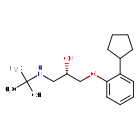
- Mechanism
- Curator reviewed
Penbutolol acts on the β1 adrenergic receptors in both the heart and the kidney. When β1 receptors are activated by catecholamines, they stimulate a coupled G protein that leads to the conversion of adenosine triphosphate (ATP) to cyclic adenosine monophosphate (cAMP). The increase in cAMP leads to activation of protein kinase A (PKA), which alters the movement of calcium ions in heart muscle and increases the heart rate. Penbutolol blocks the catecholamine activation of β1 adrenergic receptors and decreases heart rate, which lowers blood pressure.
- Primary indication
- Penbutolol is indicated in the treatment of mild to moderate arterial hypertension.Curator reviewed
- Formula / weight
- C18H29NO2 · 291.4284 g/mol (avg)
- First approval
- United States, 1995
- Code names
- HOE 893
Resolves to
KQXKVJAGOJTNJS-HNNXBMFYSA-NSMILESCC(C)(C)NC[C@H](O)COC1=CC=CC=C1C1CCCC1What you can answer from here — as of September 23, 2026
Which drugs share a target with Penbutolol, and which of those have an active Phase 3 trial?
Create a free account or log in to explore the full data card.
Create Account