KP-1461 is a potent, non-chain-terminating, mutagenic deoxyribonucleoside analogue. Designated a DNA covert nucleoside, the drug consists of a modified base that incorporates randomly into HIV and pairs with multiple bases.
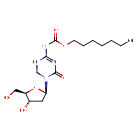
- Mechanism
- Curator reviewed
KP-1461 is the oral prodrug of KP-1212. KP-1461 is also known as SN1212. KP-1461 introduces continual mutations into HIV during viral replication by reverse transcriptase (RT). These mutations decrease virus viability and are eventually lethal. This mechanism, selective viral mutagenesis or lethal mutagenesis, is novel to the nucleoside analogue class. Unlike approved nucleoside RT inhibitors (NRTIs) that contain a modified sugar and unmodified base, KP-1461 has a modified base that allows multiple base pairing. Because KP-1461 pairs with multiple bases, it is able to target all viral proteins rather than a single protein. KP-1461, after conversion to KP-1212, is metabolized to a triphosphate and incorporated into the HIV-1 genome by RT. The drug is similarly incorporated into human mitochondrial DNA polymerase. The active substance KP-1212 has been shown to inhibit antiviral activity in tissues after just one pass; accumulation has been shown to eradicate the virus entirely. HIV strains treated with KP-1212 also showed increased sensitivity to zidovudine.
- Primary indication
- Investigated for use/treatment in HIV infection.Curator reviewed
- Formula / weight
- C16H28N4O6 · 372.422 g/mol (avg)
- Code names
- KP-1461 · SN1212
Resolves to
SZWIAFVYPPMZML-YNEHKIRRSA-NSMILESCCCCCCCOC(=O)NC1=NC(=O)N(CN1)[C@H]1C[C@H](O)[C@@H](CO)O1What you can answer from here — as of September 23, 2026
Which drugs share a target with KP-1461, and which of those have an active Phase 3 trial?
Create a free account or log in to explore the full data card.
Create Account