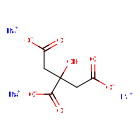
Sodium citrate is an ingredient used for the anticoagulation of whole blood as part of automated apheresis procedures. Sodium citrate is the sodium salt of citric acid.
- Mechanism
- Curator reviewed · 4 references
Citrate chelates free calcium ions preventing them from forming a complex with tissue factor and coagulation factor VIIa to promote the activation of coagulation factor X. This inhibits the extrinsic initiation of the coagulation cascade. Citrate may also exert an anticoagulant effect via a so far unknown mechanism as restoration of calcium concentration does not fully reverse the effect of citrate. Citrate is a weak base and so reacts with hydrochloric acid in the stomach to raise the pH. It it further metabolized to bicarbonate which then acts as a systemic alkalizing agent, raising the pH of the blood and urine. It also acts as a diuretic and increases the urinary excretion of calcium.
- Primary indication
- Used as an anticoagulant during plasmophoresis as well as a neutralizing agent in the treatment of upset stomach and acidic urine.Curator reviewed · 22 structured indications
- Formula / weight
- C6H5Na3O7 · 258.068 g/mol (avg)
- First approval
- Canada, 2000 · United States, 1969
- Also known as
- Natrocitral · Trisodium citrate · Trisodium citrate concentration · Trisodium-citrate
- Code names
- E-331(III) · FEMA NO. 3026, ANHYDROUS- · INS-331(III) · INS NO.331(III)
- Brand names
Resolves to
HRXKRNGNAMMEHJ-UHFFFAOYSA-KSMILES[Na+].[Na+].[Na+].OC(CC([O-])=O)(CC([O-])=O)C([O-])=OWhat you can answer from here — as of September 23, 2026
Which drugs share a target with Sodium citrate, and which of those have an active Phase 3 trial?
Create a free account or log in to explore the full data card.
Create Account