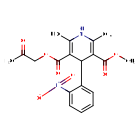
Aranidipine is a novel dihydropyridine derivative that gives rise to two active metabolites (M-1α and M-1β) that exhibit hypotensive activity. It is a calcium antagonist with the formula methyl 2-oxopropyl... It was developed by Maruko Seiyaku, introduced by Taiho and launched in Japan in 1997.
- Mechanism
- Curator reviewed · 3 references
The high potential of aranidipine is thought to be related to the additional calcium antagonistic activity of its metabolite. The mechanism is thought to be related to the capacity of aranidipine and its metabolites to vasodilate afferent and efferent arterioles. this action is performed through the inhibition of voltage-dependent calcium channels. The typical mechanism of action of aranidipine, as all dihydropyridines, is based on the inhibition of L-type calcium channels, decreasing calcium concentration and inducing smooth muscle relaxation. It is a selective alpha2-adrenoreceptor antagonist which inhibits vasoconstrictive responses.
- Primary indication
- Aranidipine has been used for many years to treat angina pectoris and hypertension.Curator reviewed
- Formula / weight
- C19H20N2O7 · 388.376 g/mol (avg)
- Code names
- MPC 1304
Resolves to
NCUCGYYHUFIYNU-UHFFFAOYSA-NSMILESCOC(=O)C1=C(C)NC(C)=C(C1C1=CC=CC=C1[N+]([O-])=O)C(=O)OCC(C)=OWhat you can answer from here — as of February 21, 2021
Which drugs share a target with Aranidipine, and which of those have an active Phase 3 trial?
Create a free account or log in to explore the full data card.
Create Account