Tubocurarine is a non-depolarizing neuromuscular blocking agent and the first identified curare alkaloid. Curare is one of the names used to describe plant-derived poisons used by indigenous South Americans to... Tubocurarine is a benzylisoquinoline derivative and shares this structural backbone with a number of plant-derived alkaloids, including morphine and papaverine.
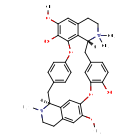
- Mechanism
- Curator reviewed · 2 references
Tubocurarine exerts its neuromuscular blocking effects via inhibition of acetylcholine (ACh) activity. It exerts a sort of reversible competitive antagonistic effect at post-synaptic nicotinic receptors, reducing the probability of activation via ACh by repeatedly associating and dissociating from these receptors - in doing so, tubocurarine prevents depolarization of the affected nerves. This mechanism distinguishes tubocurarine and similars from other neuromuscular blocking agents and is the reason they are referred to as "non-depolarizing neuromuscular blockers".
- Formula / weight
- C37H41N2O6 · 609.7312 g/mol (avg)
- First approval
- Canada, 1951
- Also known as
- d-tubocurarine · Tubocurarin
Resolves to
JFJZZMVDLULRGK-URLMMPGGSA-OSMILES[H][C@@]12CC3=CC=C(OC4=C5C(CC[N+](C)(C)[C@]5([H])CC5=CC(OC6=C(OC)C=C(CCN1C)C2=C6)=C(O)C=C5)=CC(OC)=C4O)C=C3What you can answer from here — as of September 23, 2026
Which drugs share a target with Tubocurarine, and which of those have an active Phase 3 trial?
Create a free account or log in to explore the full data card.
Create Account