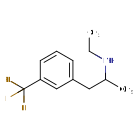
Fenfluramine is fenfluramine is a phenethylamine that is structurally similar to serotonin. Due to its ability to increase extracellular serotonin levels, modulate serotonergic and other neurologic receptors, and control neurotransmission, it is effective in treating pharmacoresistant seizures. Dravet syndrome is a pediatric encephalopathy that typically manifests within the first year of life following exposure to elevated temperatures.
- Mechanism
- Curator reviewed · 30 references
Dravet syndrome is a complex pediatric encephalopathy characterized by recurrent pharmacoresistant seizures of variable type, delayed development, and in many cases, impairment in speech, language, gait, and other neurocognitive functions. Despite substantial variation in presentation and severity, roughly 80% of patients with Dravet syndrome have mutations in the SCN1A gene, which encodes the alpha subunit of a voltage-gated sodium channel (Nav1.1). This channel is predominantly localized in inhibitory GABAergic interneurons as well as in excitatory pyramidal neurons; it is thought that dysfunction of neurotransmission regulation results in the seizures and other corresponding symptoms of Dravet syndrome.
Various in vitro and in vivo studies have demonstrated that fenfluramine is capable of acting as an agonist of multiple serotonin receptors including 5-HT1A, 5-HT1D, 5-HT2A, 5-HT2B, and 5-HT2C, as well as a σ1 receptor antagonist. This is at least partly because fenfluramine, as well as its active metabolite norfenfluramine, can act on sodium-dependent serotonin transporters (SERTs) to reverse transport direction and thereby increase extracellular serotonin levels. However, work in animal models of Dravet syndrome suggest that only the modulation of 5-HT1D, 5-HT2C, σ1, and possibly 5-HT2A receptors of fenfluramine result in the anti-epileptiform activity. Interestingly, 5-HT2B receptor agonism, which had previously been associated with cardiac valvulopathy, is not anticipated to have any therapeutic value in Dravet syndrome.
Although the exact mechanism by which stimulation/inhibition of various receptors leads to the observed therapeutic benefit is unclear, it is hypothesized to be two-fold. Stimulation of 5-HT1D and 5-HT2C may result in increased GABAergic neurotransmission, while σ1 receptor antagonism may help to modulate responses to N-methyl-D-aspartate (NMDA).
- Primary indication
- Fenfluramine is indicated for the treatment of seizures associated with Dravet syndrome and Lennox-Gastaut syndrome in patients aged two years and older.Curator reviewed · 2 structured indications
- Formula / weight
- C12H16F3N · 231.2573 g/mol (avg)
- First approval
- Canada, 1991 · United States, 2020 · European Union, 2021
- Also known as
- Fenfluramina
- Code names
- DEA No. 1670 · S 768
- Brand names
Resolves to
DBGIVFWFUFKIQN-UHFFFAOYSA-NSMILESCCNC(C)CC1=CC=CC(=C1)C(F)(F)FWhat you can answer from here — as of September 23, 2026
Which drugs share a target with Fenfluramine, and which of those have an active Phase 3 trial?
Create a free account or log in to explore the full data card.
Create Account