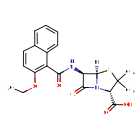
Nafcillin is a penicillin derivative antibiotic used to treat susceptible staphylococcal infections. A semi-synthetic antibiotic related to penicillin, Naficillin is a narrow-spectrum beta-lactam antibiotic drug.
- Mechanism
- Curator reviewed · 1 reference
Like other penicillins, nafcillin exerts a bactericidal action against penicillin-susceptible microorganisms during the state of active multiplication in the bacterial cell wall synthesis. It inhibits the biosynthesis of the bacterial cell wall by forming covalent bonds with penicillin-binding proteins that play a critical role in the final transpeptidation process. Binding to penicillin-binding proteins inhibits the transpeptidase and carboxypeptidase activities conferred by these proteins and prevents the formation of the crosslinks.
- Primary indication
- Indicated in the treatment of infections caused by penicillinase-producing staphylococci which have demonstrated susceptibility to the drug.Curator reviewed · 1 structured indication
- Formula / weight
- C21H22N2O5S · 414.475 g/mol (avg)
- First approval
- Canada, 1994 · United States, 1984
- Also known as
- Naphcillin
Resolves to
GPXLMGHLHQJAGZ-JTDSTZFVSA-NSMILES[H][C@]12SC(C)(C)[C@@H](N1C(=O)[C@H]2NC(=O)C1=C(OCC)C=CC2=CC=CC=C12)C(O)=OWhat you can answer from here — as of September 23, 2026
Which drugs share a target with Nafcillin, and which of those have an active Phase 3 trial?
Create a free account or log in to explore the full data card.
Create Account