Thiothixene is an antipsychotic indicated for the management of schizophrenia. A thioxanthine used as an antipsychotic agent.
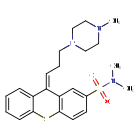
- Mechanism
- Curator reviewed
Thiothixene acts as an antagonist (blocking agent) on different postsysnaptic receptors -on dopaminergic-receptors (subtypes D1, D2, D3 and D4 - different antipsychotic properties on productive and unproductive symptoms), on serotonergic-receptors (5-HT1 and 5-HT2, with anxiolytic, antidepressive and antiaggressive properties as well as an attenuation of extrapypramidal side-effects, but also leading to weight gain, fall in blood pressure, sedation and ejaculation difficulties), on histaminergic-receptors (H1-receptors, sedation, antiemesis, vertigo, fall in blood pressure and weight gain), alpha1/alpha2-receptors (antisympathomimetic properties, lowering of blood pressure, reflex tachycardia, vertigo, sedation, hypersalivation and incontinence as well as sexual dysfunction, but may also attenuate pseudoparkinsonism - controversial) and finally on muscarinic (cholinergic) M1/M2-receptors (causing anticholinergic symptoms like dry mouth, blurred vision, obstipation, difficulty/inability to urinate, sinus tachycardia, ECG-changes and loss of memory, but the anticholinergic action may attenuate extrapyramidal side-effects).
- Primary indication
- For the management of schizophrenia.Curator reviewed · 1 structured indication
- Formula / weight
- C23H29N3O2S2 · 443.625 g/mol (avg)
- First approval
- Canada, 2005 · United States, 1967
- Also known as
- cis-thiothixene · Tiotixene
- Code names
- CP-12252-1 · NSC-108165 · P-4657 B
Resolves to
GFBKORZTTCHDGY-UWVJOHFNSA-NSMILESCN(C)S(=O)(=O)C1=CC2=C(SC3=CC=CC=C3\C2=C\CCN2CCN(C)CC2)C=C1What you can answer from here — as of October 20, 2026
Which drugs share a target with Thiothixene, and which of those have an active Phase 3 trial?
Create a free account or log in to explore the full data card.
Create Account